Getting Your First Full Denture — A Banghak Station Dentist on the Process and the Adjustment Period
Key takeaway A full denture takes about four to six weeks to make and roughly two to three months to get used to. Most of the discomfort in the first month is resolved by adjustment, not endurance. The fabrication steps, what to do when it hurts, health insurance from age 65, and the option of adding implants.
Hello. I'm Dr. Oh Ji-hwan, director of Yonsei The Strong Dental Clinic.
Timing first. A full denture takes about four to six weeks to make, and roughly two to three months to get used to. And most of the discomfort in that first month is resolved by adjustment. I lead with that because some people, not knowing it, put the denture in a drawer during the first week.
Faces tend to tighten when full dentures come up in the consultation room. "I hear you can't chew anything with those." Half true, half not. It won't chew like natural teeth, but I have patients eating again with a well-fitted denture what they'd given up on. The difference usually comes down to how the first two or three months went. I say this first to everyone coming from Banghak Station, one stop up the line.
So here is the whole process. How a full denture stays in at all, how many visits it takes to make, what to do when it hurts, the conditions under which health insurance applies, and what adding a couple of implants involves.
What actually holds a full denture in
A full denture is held not by screws or adhesive but by suction created as it seats against the gum, balanced by the surrounding muscles.
Understanding that makes everything else follow. A thin film of saliva forms between the fitting surface and the gum, and the two cling together — that's the core of the retention. So the gum's shape and the denture's inner surface have to match precisely; a small discrepancy lifts it or hurts.
Two things come out of that. First, how much jawbone remains largely governs retention. Someone whose teeth came out long ago, with substantially resorbed ridges, gets less grip from the same denture. Second, gums keep changing. Over years the bone shrinks and the original fit loosens. At that point the answer isn't necessarily a new denture — the inner surface can be relined to match again.
Upper and lower differ too. The upper has the broad palate, so the contact area is large and it generally holds well. The lower has the tongue moving and a narrow contact area, and it's harder. "My lower denture keeps lifting" is a matter of structure, not skill.
Full denture, partial denture, implant
| Item | Full denture | Partial denture | Implant |
|---|---|---|---|
| For | No teeth remaining | Some teeth remaining | Any number, if bone allows |
| How it's held | Suction against the gum | Clasps on remaining teeth | Fixtures in the bone |
| Rough timeline | About 4–6 weeks | About 3–5 weeks | About 3–9 months |
| Chewing force | Weaker than natural teeth | Better than a full denture | Closest to natural |
| Removed for cleaning | Yes | Yes | Fixed in place |
| Adjustment as gums change | Needed | Needed | Comparatively less |
None of them is the answer on its own. Remaining teeth, bone volume, general health and what you can realistically manage all go into it. For anyone with reduced hand strength or eyesight, "taking it out and cleaning it every day" is a bigger variable than it sounds, so it helps to say so plainly at the consultation.
Which way might suit you now
- Almost no teeth remain in the upper or lower jaw
- You've been told the remaining teeth are too loose to last
- Years have passed since extraction and the ridges have resorbed
- Reduced hand strength makes handling small objects difficult
- Removing and cleaning something daily isn't a burden
- You take diabetes or osteoporosis medication
The first three point toward dentures. If the fifth feels burdensome we look at fixed options alongside, and the last is what divides implant candidacy — bring your medication list as it is and the assessment goes faster.
With the principle covered, here's the making of it.
How many visits does it take?
A full denture goes impression → establishing the height → checking the tooth set-up → completion → adjustment, usually across about five visits.
- Visit 1 — assessment and preliminary impression. We check the gum condition and remaining bone and take a rough impression. If teeth still need removing, the order is set here. About 30–40 minutes.
- Visit 2 — definitive impression. With a tray made for you, we capture right out to the gum margins. This step governs the fit, so it's better not to rush even if it takes a while.
- Visit 3 — establishing height and position. We set how the jaws meet, how much of the front teeth shows, and the facial midline. This is where your facial appearance is decided, and we check it together in a mirror.
- Visit 4 — checking the tooth arrangement. Teeth set in wax are tried in, and you look at shape and shade while we make changes. This is the last point at which things can be altered before completion, so say what you think freely here.
- Visit 5 — fitting the finished denture. The completed denture goes in and contact points are relieved. It's sometimes comfortable that day, but more often not.
- After that — adjustment. Two or three visits a few days apart, easing the sore spots. This adjustment process is what actually completes a denture.
If teeth still need extracting, the healing period is added ahead of all this. With that included, some cases run two to three months.
Questions I'm often asked
Q. Do I go without teeth while it's being made? A. If teeth have to come out, an immediate denture can be made and fitted first. The gum changes shape as it heals, so the usual flow is a temporary for that period and then the definitive one.
Q. Will I be able to chew from the start? A. Mostly not. The first week starts with soft food and practising chewing slowly on both sides. Measuring against your chewing power with natural teeth leads to disappointment — measure against yourself in two or three months.
Q. My speech has gone strange. A. A common course. Sibilant sounds are the ones that go first, and as the tongue adapts to the new thickness it usually settles within two to four weeks. Reading aloud speeds it up.
Q. Should I sleep in it? A. Generally I'd suggest taking it out. The gum needs rest, and constant pressure makes the bone shrink faster. Where there's grinding or another particular reason, the advice can differ.
Q. Can I use adhesive? A. As a supplement, yes. But relying on adhesive is usually a sign the fitting surface no longer matches. If you find yourself using it continually, that's the point at which adjustment or a reline is due.
Q. How often does it need replacing? A. It depends how fast the bone resorbs. Relining the inner surface when it loosens comes first; when that's not enough, a new one is made. Insurance conditions are below.
Q. I have a few teeth left. Do those have to come out too? A. It depends on their state. A tooth still firmly held in bone gives a partial denture an advantage in chewing force. Conversely, forcing a loose tooth to stay means the clasp destroys it faster. Sorting which to keep and which to remove is the core of the first consultation, decided on an image.
Q. It makes me gag and I can't wear it. A. That's the back edge of an upper denture sitting close to the throat. Trimming the posterior extension or reducing the thickness often helps, and short repeated wearing periods build tolerance. It's not something to endure — say so and it can be adjusted.
With the process clear, here's the cost side.
Cost and health insurance
Full dentures are covered by national health insurance from age 65, with a 30% patient share, on a once-every-seven-years basis.
One misunderstanding is worth heading off. Insured dentures come with set materials and fabrication methods, and choosing outside that range makes them uninsured. Remaking within seven years also requires meeting exception criteria. It isn't "insured, so a new one whenever" — which is why taking the time to get the first one right pays off.
| Item | Notes |
|---|---|
| Full denture (age 65+) | Insured, 30% patient share, once every seven years |
| Partial denture (age 65+) | Insured, same conditions |
| Partial denture (uninsured) | Posted in-clinic: 2,500,000 KRW |
| Implant locator for a denture | 300,000 KRW each |
| Reline and repair | Depends on the condition |
The full list is on our fees page, and period-specific notices are posted inside the clinic. Whether coverage applies turns on age and remaining teeth, so asking "does coverage apply in my case?" first makes the plan clear.
Daily care is only four things
It isn't complicated. But these four are daily.
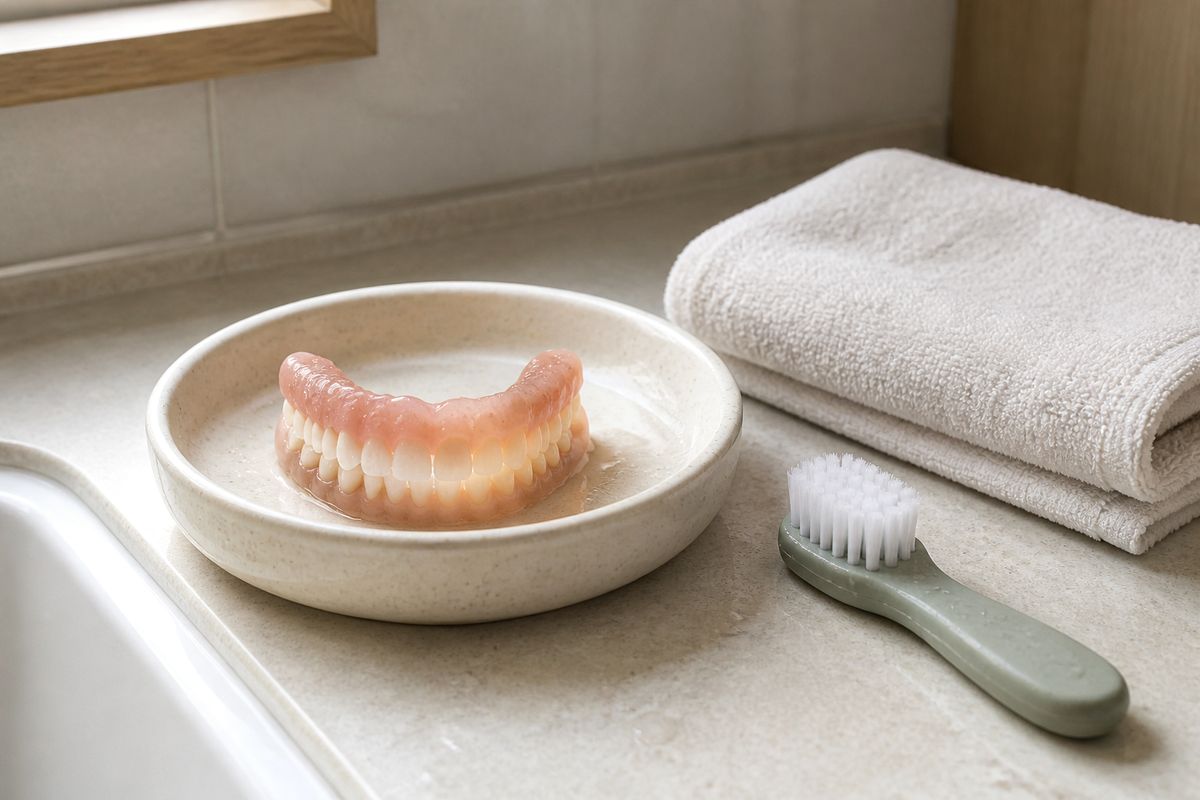
One, take it out and rinse after meals. Food trapped against the fitting surface damages the gum. If every meal is unrealistic, at least do it properly once a day.
Two, clean with a denture cleaner or dish soap, not toothpaste. Ordinary toothpaste contains fine abrasives that scratch the denture surface, and scratches hold biofilm. A soft brush under running water is enough.
Three, no hot water. Soaking it in boiling water to sterilise it warps the denture. Once distorted it no longer fits, and that's hard to reverse by adjustment.
Four, store it in water when it's out. Left dry, the material shrinks and shifts slightly. Take it out each night into a container of water.
One more thing on top: after removing it, brush your gums and tongue gently too. The gum needs time to recover from being compressed, and clearing biofilm off the tongue reduces both odour and fungal problems.
Will my face look different?
It will — and usually for the better.
Going a long time with no teeth lowers the height between the jaws. The area around the mouth folds inward, the lips look thinner, and the nose and chin appear closer together. A denture restores that height, so a well-made one brings the face back near its original proportions.
That's why the third visit, where height and front-tooth position are set, matters so much. Too high and it's hard to close and the gums hurt; too low and the mouth still looks collapsed. Check it in the mirror with us at that stage and say what bothers you then — far easier than changing it after completion.
Getting through the first three months
What decides the outcome with a full denture isn't only the making — it's the first three months of adaptation.
By stage:
| Stage | What happens, and how to get through it |
|---|---|
| Days 1–3 | Peak awkwardness, heavy salivation. Soft food only |
| Week 1 | Pressure sore spots reveal themselves. This is when to come for adjustment |
| Weeks 2–4 | Speech begins to settle. Practise chewing on both sides |
| Months 1–2 | Most soreness resolves. Widen the range of foods |
| Months 2–3 | Growing familiar. Still go carefully with tough and hard foods |
| Every six months after | Check the gum and the fit before it loosens |
The critical part is week one. Enduring a sore spot creates an ulcer, and that ulcer can end with the denture unwearable altogether. Coming in for adjustment when it hurts is the normal route, and the adjustment usually takes minutes.
One request: when you come in sore, don't leave the denture out. Wear it for at least two or three hours beforehand so the pressure marks are visible on the gum and we can relieve exactly the right spot.
Chewing practice, in this order
- Week 1: porridge, tofu, steamed egg — things that need no chewing
- Week 2: finely chopped greens, soft fish, cooked vegetables
- Weeks 3–4: rice and meat cut small, using both back teeth together
- After that: widen the range, saving tough and hard foods for last
- Ongoing care: squid, dried nuts, toffee, rice cake — sticky or hard
Chewing on one side lifts the other. A full denture works on the principle of using both sides at once, and that one habit noticeably changes how fast you adapt.
Biting with the front teeth is also best avoided at first. Force at the front lifts the back and the whole denture rocks. Foods you used to bite into, like apples or gimbap, go down much more easily cut up and taken to the back teeth. After two or three months this eases off naturally.
If this happens
One spot keeps hurting. That means only that point is under pressure, and adjustment resolves most of them. Don't put up with it — come in.
The lower denture keeps lifting. The lower jaw is structurally harder to retain. Adjustment sometimes improves it; where it doesn't, we consider placing two implants for the denture to clip onto.
Food gets underneath. That signals a gap between gum and fitting surface. Relining the inner surface usually reduces it.
The gum is sore and looks white and peeling. There may be an ulcer, or a fungal overgrowth. That calls for resting the denture briefly alongside treatment to let the gum recover.
I dropped it and it cracked. Don't glue it and carry on — bring it in. Badly rejoined, the bite goes off and the gum suffers more. Cleaning it over a basin filled with water means a drop doesn't break it.
I'm worried about my breath. Biofilm on the denture surface is often the cause. Daily cleaning and storing it in water resolves most of it. If it persists, the gums or tongue may need looking at as well.
It's loosened since I lost weight. A large change in weight changes gum thickness too. It genuinely happens, and relining usually solves it.
The option of adding a couple of implants
There's an approach for when the lower denture simply won't stay put: placing about two implants and clipping the denture onto them.
This isn't the same as replacing everything with implants. The denture stays; only the anchor points are added, so the number is small and the cost is correspondingly lower. It usually reduces the lifting sensation while chewing and lets people get by without adhesive.
It does require a reasonable amount of remaining bone, and a waiting period after placement while the implants integrate. General health has to be considered too. Rather than starting here, I tend to suggest living with a conventional denture first and reviewing this if the lower jaw remains a problem. There's more on our implant page.
What to check when choosing a clinic
A denture isn't an object that's finished when made — it's a treatment completed by adjustment. So the things to check cluster there.
- Do you get to try it in and change it before completion? Look for a wax try-in where shape and height are shown to you.
- Are adjustment appointments booked in advance? Two or three adjustments after fitting are standard, not an exception.
- Are you clearly told to come in when it hurts? If the only explanation is "you'll get used to it," reconsider.
- Is coverage and its conditions sorted out first? The age and seven-year rules have to be known up front for a plan to hold.
- Do they talk about care years ahead? Gums keep changing, and a reline becomes necessary eventually.
- Are the hours ones you can keep? Fabrication plus adjustment means five or six visits at least.
Where things commonly go wrong
- Putting it in a drawer in week one because it hurts — the most common and the most regrettable. Pain at that stage is something to adjust.
- Getting by on adhesive indefinitely — that covers up a signal that it doesn't fit, and the gum suffers more.
- Using a loosened denture for years — a bite that has gone off makes the bone shrink faster.
- Chewing on one side only — the other side lifts and adaptation drags.
Coming from Banghak Station
Banghak Station is one stop toward Uijeongbu on Line 1, though we're not right by the station. Taking the subway, the walking at both ends adds up to around ten minutes all in. The clinic is about a five-minute walk from Exit 1 of Dobong Station, heading toward the Dobong 1-dong post office, and there's in-building parking if you drive (parking guide). If mobility is limited, look at the route on our how to find us page first. Many of our patients come from Banghak-dong in Dobong-gu.
We're open until 9 p.m. on weekdays, until 2 p.m. on Saturdays, from 2 p.m. to 6 p.m. on Sundays, and on public holidays. For treatment that brings you back often for adjustment, that matters in practice. Credentials are on the dental team page.
To sum up
One, four to six weeks to make, two to three months to get used to. Discomfort in the first week isn't failure — it's the stage that needs adjusting.
Two, when it hurts, don't endure it, and wear it in. The pressure marks have to be visible for us to relieve the right spot, and the adjustment usually takes minutes.
Three, from age 65 it's insured, on a once-every-seven-years basis. It isn't a structure that allows frequent remakes, so getting the first one right pays.
Gum condition and adaptation speed vary widely, so an article can't settle your case. If the denture you have is uncomfortable, or you're about to have your first made, starting with a look at your gums is enough. Any questions, feel free to call us at 02-954-2080.
A full denture is finished not on the day it's made but on the day the adjustments end. Yonsei The Strong Dental Clinic is about a five-minute walk from Exit 1 of Dobong Station, open until 9 p.m. on weekdays and on weekends and public holidays.