"They Said My Wisdom Tooth Is Sitting on the Nerve — A Suraksan Station Dentist's A-to-Z on Impacted Wisdom Teeth"
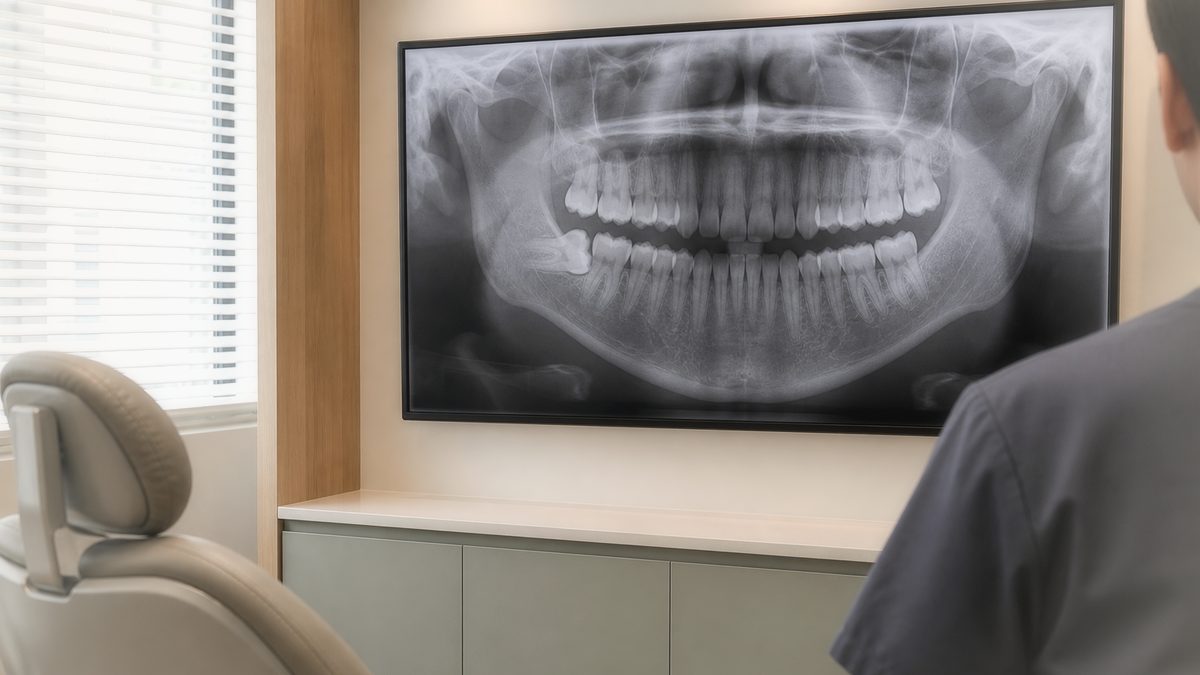
Key takeaway Two teeth called "a wisdom tooth" can differ completely in difficulty depending on how they lie and how close they sit to the nerve. Why impacted wisdom teeth are hard, when a panoramic X-ray isn't enough and 3D imaging is needed, what the nerve risk really means, anesthesia options, recovery and cost.
Hello. I am Dr. Oh Ji-hwan of Yonsei The Strong Dental Clinic.
Let me start with the conclusion. Even "one wisdom tooth" varies completely in difficulty depending on the direction it lies and its distance from the nerve. A wisdom tooth that takes ten minutes and one that requires 3D imaging and a planned approach share nothing but the name.
I hear this often in the chair: "Another clinic said it's sitting on the nerve and they couldn't take it out — go to a hospital." After hearing that, people put it off for years out of fear. A patient from Gongneung-dong said it, and so do people who come by bus number 7 from Suraksan Station. But that sentence usually isn't scaremongering — it is an accurate assessment. What was missing was an explanation of what is difficult.
Today I want to fill in that missing part: why impacted wisdom teeth are hard, when a single panoramic film isn't enough and we take 3D imaging, what the nerve risk actually is and how to read the numbers you find online, how anesthesia is chosen, and how recovery and cost work. I'll also lay out which wisdom teeth are better removed now and which can be watched.
What makes a wisdom tooth difficult — four factors
The difficulty of a wisdom tooth extraction is largely settled before anyone touches it, by where the tooth sits, at what angle, and next to what.
First, the direction it lies. A wisdom tooth standing upright and fully erupted is close to a routine extraction. One tilted forty-five degrees into the tooth in front, one lying fully sideways, or rarely one facing backwards cannot simply be pulled — it has to be sectioned and removed in pieces.
Second, how buried it is. A tooth covered only by gum and one fully enclosed in bone differ from the first step. Once bone has to be opened, both time and swelling increase.
Third, the distance to the lower jaw nerve. Beneath the lower molars runs a canal carrying the nerve that supplies sensation to the lower lip and chin. The closer a wisdom tooth's roots sit to that canal — especially when the roots wrap around it — the higher the difficulty and the care required. This is where "it's sitting on the nerve" comes from.
Fourth, in the upper jaw, the relationship to the sinus. Upper wisdom teeth sit near the maxillary sinus, so roots straddling that boundary call for a careful approach.
Age sits on top of all of this. In the early twenties, roots are not fully formed and bone is more yielding, which makes things comparatively easier; with age, roots lengthen and bone hardens, so the same tooth becomes harder. That is why people say "if it's coming out anyway, do it young."
How the levels differ
| Type | Condition | Rough time | Recovery | Notes |
|---|---|---|---|---|
| Fully erupted | Upright, fully out | About 5–15 min | 1–2 days | Close to a routine extraction |
| Partially impacted | Only partly through the gum | About 15–30 min | 2–4 days | Gum incision, sometimes sectioning |
| Fully impacted (in bone) | Completely enclosed in bone | About 30–60 min | 4–7 days | Bone removal plus sectioning |
| Nerve-adjacent | Roots touching or wrapping the canal | About 30–60 min or more | 5–7 days | 3D imaging essential, planned approach |
The times are reference ranges. In practice, root shape alone can make it finish faster or run longer. But looking at this table explains why "how long does it take?" is hard to answer in one number.
Signs it's better removed now
- The gum around it swells and hurts repeatedly
- There is an odor or visible pus from that area
- You have had episodes where your mouth wouldn't open properly
- Food constantly packs between it and the molar in front
- You've been told the molar touching it has developed decay
- Your toothbrush doesn't reach that far back
- You are in your twenties and were told it's lying down on the image
- Your cheek on that side has swollen enough to change your face shape
- Since it came in, your brush picks up blood from behind it
Conversely, a wisdom tooth that came in upright, cleans well, causes no symptoms and doesn't affect the tooth in front is perfectly reasonable to leave and monitor. Not every wisdom tooth has to come out.
With causes and difficulty covered, let's look at how we actually check.
Panoramic vs. 3D imaging — what's the difference
A panoramic film shows direction and rough position; 3D imaging shows the distance to the nerve canal in three dimensions.
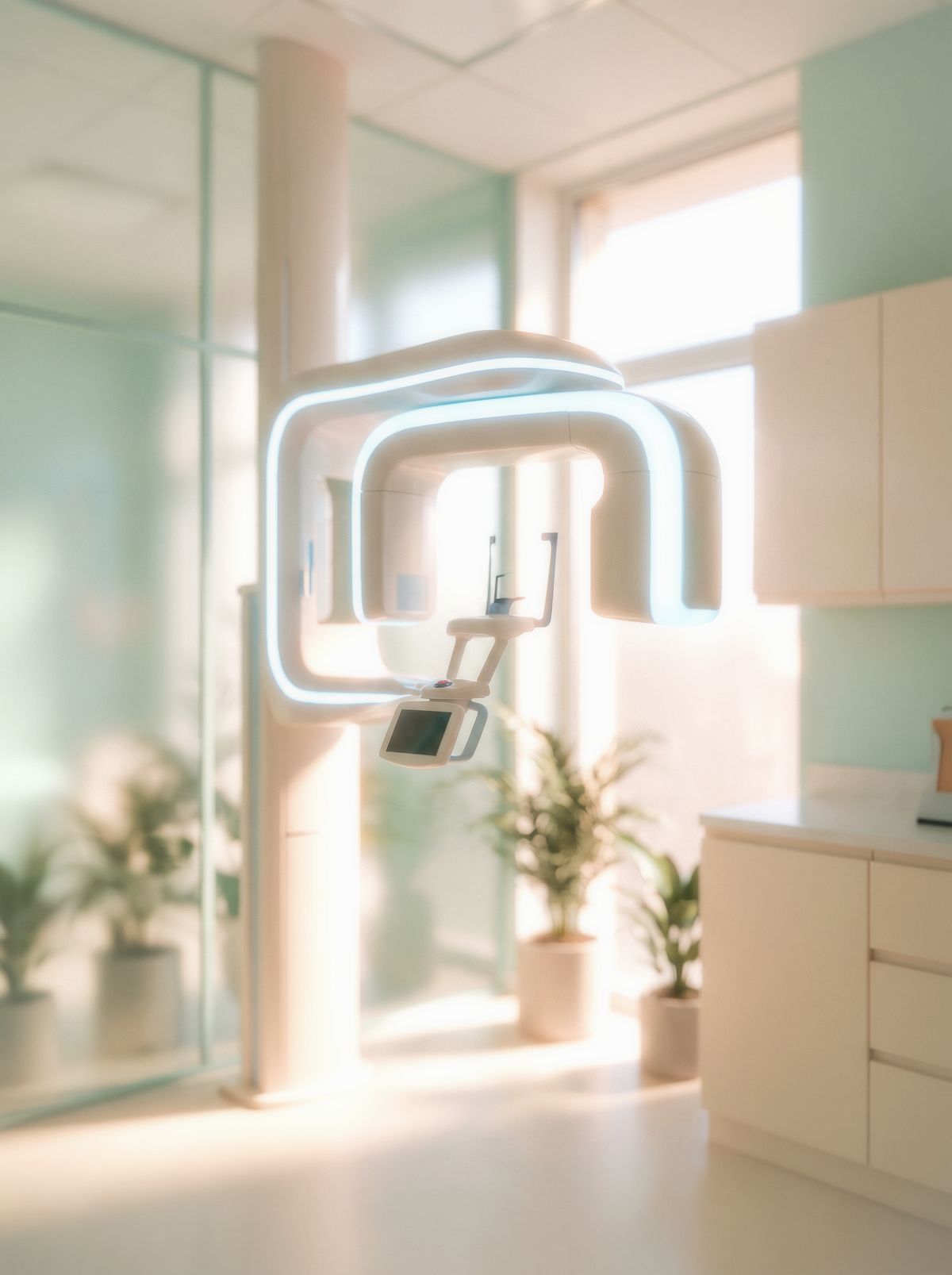
A panoramic radiograph unrolls the whole jaw onto a single image. It shows which way the wisdom tooth lies, how many roots it has, and whether the roots overlap the nerve canal — and for most cases the judgment ends there.
The catch is that a panoramic film flattens three dimensions onto a plane. Roots and canal may overlap on the image while actually passing to the inside or outside of each other. The reverse also happens: no overlap on the film, yet genuinely close. So we recommend 3D imaging under these conditions:
- The roots and the nerve canal overlap on the panoramic film
- The roots are hooked or appear numerous
- Full impaction means the approach route must be planned in advance
- There has been repeated inflammation in that area
Taking 3D imaging is not about frightening you — it is about mapping a route around the nerve in advance. Skipping it is the riskier path. If radiation dose concerns you, we image only where it is indicated and explain that judgment as well.
The nerve risk, honestly
This is probably what you most want to know and what searching answers least well. In short: nerve-related symptoms are uncommon but not zero, most are temporary, and the risk is reduced by pre-operative imaging and planning.
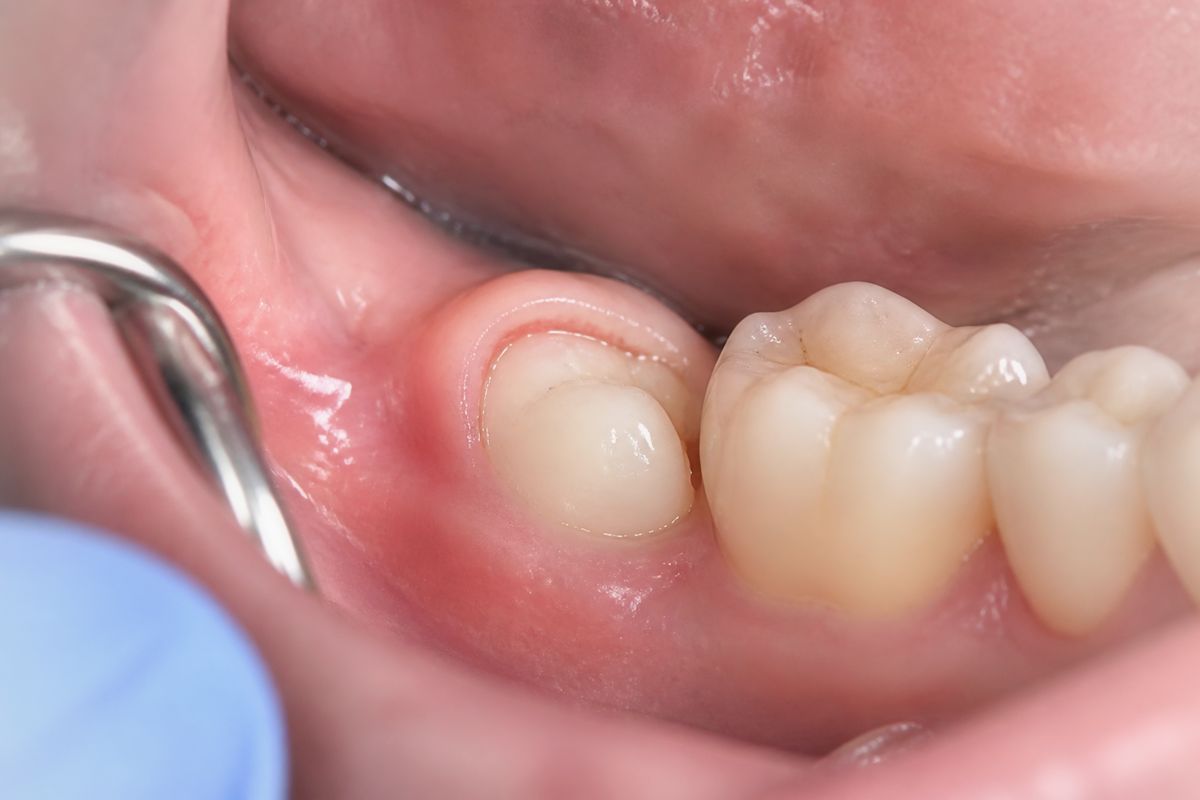
When a lower wisdom tooth sits close to the canal, intra-operative irritation can leave tingling or dulled sensation in the lower lip or chin. Most resolve over weeks to months, though rarely it persists. Two things matter here.
First, this risk differs from tooth to tooth. For a wisdom tooth far from the canal it is effectively a non-issue; for one whose roots wrap the canal it needs planning. So applying a single percentage found online to your own tooth means little. The distance measured on your own image is your risk.
Second, it is a reducible risk. Confirming the route on 3D imaging, sectioning the tooth so that force never travels toward the nerve, and not forcing anything — that process lowers it. It is also why such cases take longer.
I should add that in very difficult cases we sometimes deliberately leave part of a root. Rather than forcing out a root tip sitting directly on the nerve, it is left in place and monitored. It isn't used in every case, but it is an option for lowering risk when conditions suit. Knowing this option exists makes consultations much easier to follow.
Questions that come up in the chair
Q. I was told to go to a large hospital — do I have to? A. That is usually an accurate assessment that the case is difficult. It doesn't have to be a university hospital, though — anywhere that can confirm the anatomy with 3D imaging and work to a plan will do. If you have systemic conditions, need general anesthesia because cooperation is difficult, or have the unusual anatomy of roots fully encircling the canal, a higher-level facility may be the better choice. Look at the images, hear why it's difficult, and decide from there.
Q. It doesn't hurt — do I still need it out? A. Sometimes removal is better even without symptoms: when decay is forming where it contacts the molar in front, when a cyst-like lesion is visible around it, or when there are traces of repeated inflammation. A well-erupted, well-cleaned wisdom tooth can be watched. The image, not the symptoms, is the standard.
Q. Can upper and lower be done together? A. Doing the upper and lower on the same side together is common, so you can still chew on the other side. Doing both sides at once makes eating considerably harder for several days. We adjust to your condition and schedule.
Q. Is sedation safer? A. Comfort and safety are different questions. Sedation helps when anxiety is high or the procedure will run long, but it is safe when paired with health assessment and monitoring. You may ask which agents are used and who watches your status during the procedure. Most wisdom teeth are fine under local anesthesia.
Q. Will removing a wisdom tooth slim my jawline? A. Wisdom teeth aren't related to the angled part of the jawbone, so it is hard to say extraction changes face shape. Right afterward you'll look fuller from swelling, and you return to normal once it settles. There's no need to have one removed for the sake of your face shape.
Q. What about during menstruation or pregnancy? A. In pregnancy we generally postpone until after delivery unless there is acute infection. When it truly can't wait, timing and method are decided together with your obstetric care. Let us know how far along you are.
Upper and lower wisdom teeth are different
Even on the same day and the same side, the upper and lower experiences differ noticeably. Knowing this in advance prevents the "the lower one was fine, why is the upper like this?" worry.
| Aspect | Upper wisdom tooth | Lower wisdom tooth |
|---|---|---|
| Nearby structure | Maxillary sinus (air space) | The lower jaw nerve canal |
| Bone quality | Relatively soft | Dense |
| Typical duration | Shorter | Longer |
| Swelling | Less | More |
| Main precaution | Avoid communicating with the sinus; don't blow your nose hard | Avoid nerve irritation; limited mouth opening |
Avoid blowing your nose hard after an upper extraction in particular. If the roots were near the sinus, that pressure transmits directly to the healing site. Sneeze with your mouth open.
Lower wisdom teeth, by contrast, bring several days of limited mouth opening. It is the chewing muscles reacting, usually eases in three to five days, and forcing your mouth wide isn't helpful.
With imaging and risk covered, on to the procedure and recovery.
The procedure and recovery — days two to three are the peak
An impacted extraction runs: anesthesia → gum incision → bone removal if needed → sectioning the tooth → removal → irrigation → sutures.

Many people find the sectioning step alarming, but it is precisely how we disturb less surrounding bone and nerve. Removing a tooth whole would mean opening wider and applying far more force.
How it progresses
- Day of — Bite firmly on gauze for around two hours. No spitting, no straws (they pull out the clot). Repeat cold compresses.
- Days 1–3 — The peak of swelling, worst around day two or three, then easing. Take medication on schedule.
- Days 3–5 — Swelling recedes and bruising yellows. Switch to warm compresses. Limited mouth opening loosens around now.
- Days 5–7 — Sutures out. Pain has largely gone.
- Weeks 2–4 — The socket gradually fills in. If food packs in, rinse rather than digging at it.
One warning sign. If pain eases and then worsens again from days three to five with a bad odor, it may be a dry socket — the clot has been lost and bone is exposed, which is genuinely painful. Treatment makes it much more comfortable, so don't endure it. Smoking and straws are the most common causes.
What not to do after extraction
- Straws — the suction pulls out the clot (the leading cause of dry socket)
- Frequent spitting or vigorous rinsing — same reason
- Smoking — hinders healing through both pressure and chemistry; hold off at least a few days
- Alcohol — slows clotting and worsens swelling
- Hot soups, saunas, hard exercise — postpone until swelling settles
- Checking the site with your tongue or fingers — it reopens healing tissue
- Not brushing that side at all — avoid the socket, brush everything else normally
When to contact us. ① Bleeding that won't stop despite continued gauze pressure ② Pain returning and worsening from days three to five with an odor ③ Numbness of the lip or chin still present the next day ④ Fever, or swelling severe enough to make swallowing difficult. Don't watch and wait on these four.
Recovery speed varies considerably. At the same difficulty, age, general health and smoking can shift it by days.
Cost and insurance — extraction is covered
Wisdom tooth extraction is covered by national health insurance, and the calculation varies with difficulty.
| Item | Coverage | Notes |
|---|---|---|
| Simple extraction | Covered | Upright wisdom tooth |
| Complicated extraction | Covered | Requires incision or sectioning |
| Impacted extraction | Covered | Buried in bone; highest calculation |
| Panoramic radiograph | Covered | Basic diagnosis |
| Three-dimensional imaging | Conditional | Where necessity is recognised |
| Sutures, dressing, suture removal | Covered | Follow-up visits |
| Sedation | Generally not covered | Conditions require consultation |
Out-of-pocket cost commonly falls around ₩10,000–70,000 per tooth depending on difficulty and imaging, rising above that with deep impaction plus 3D imaging. Sedation is billed separately. These figures vary with calculation standards and by clinic, so treat them as reference and confirm after examination.
A question I get often: "Do difficult wisdom teeth cost more?" Yes — the insurance calculation itself is tiered by difficulty. But that tiering isn't set at a clinic's discretion; it follows defined criteria, so you can simply ask which category yours was billed under.
What waiting costs
- It gets harder with age. Roots complete and bone hardens, raising the difficulty of the same tooth.
- You can lose the molar in front. If the second molar pressed by the wisdom tooth decays, what would have been one extraction spreads into treating that molar too. That is the more painful loss.
- Repeated inflammation erodes bone. It eats into surrounding bone, making that site harder to restore later.
Choosing where to have it done
An extraction is a one-visit treatment, but what was checked before starting decides the outcome.
- Do they show you the image and explain why it's difficult? The standard is pointing out roots and canal on screen, not just saying "it's hard."
- Do they explain why 3D imaging is or isn't needed? Neither "always image" nor "never image" is right; there should be reasoning.
- Do they tell you the risks in advance? A clinic that explains possible nerve symptoms and how they're handled before the extraction is a prepared one.
- Do they say when they shouldn't do it? Being told plainly that a case is better handled at a higher-level facility is a mark of trustworthiness.
- Can you reach them afterward? Swelling and pain get worse at night. Having somewhere to ask at that hour is a real difference.
- Do they ask about conditions and medications first? Anticoagulants and osteoporosis drugs affect the plan.
Clinician credentials can be verified through public records even at a community clinic. Our team is on the doctors page — apply the same standard elsewhere.
Sometimes it's better to wait
Even a wisdom tooth that should come out doesn't always need to come out now.
- During acute infection — With swelling, fever and a mouth that won't open, anesthesia works poorly and infection can spread. Settle the inflammation first, then extract a few days later.
- Right before something important — Exams, presentations, travel. Swelling is unpredictable; there's no reason to schedule it then.
- While on anticoagulants — Don't stop them yourself; timing is set after discussion with your prescribing physician.
- With uncontrolled blood pressure or blood sugar — Getting those in range first favors recovery.
- During pregnancy — Generally postponed until after delivery unless infection is acute.
Conversely, what shouldn't wait: the molar in front already deteriorating, a visible cyst-like lesion, or inflammation recurring at shortening intervals. Those three only get more costly with time.
In closing
Three things to take away. First, difficulty is already set by the direction it lies, how buried it is, and its distance from the nerve — "this is difficult" is usually an accurate assessment, not a scare tactic. Second, when roots and canal overlap on a panoramic film, mapping the route with 3D imaging first is the safe order — skipping that step is the risk. Third, not every wisdom tooth needs removal, but the ones that do are easier when you're young — as roots complete and bone hardens, the same tooth gets harder.
One more thing: at a consultation, asking "how does it look on my image?" gets you a far better answer than "should it come out?" The first question returns generalities; the second returns your own tooth. Look at the screen together, check the angle and the distance, and whether to remove or monitor usually resolves itself right there.
If you've been putting it off for years since hearing "it's on the nerve," start by finding out how close it actually is on your image. Whether there's more room than you feared or a plan is genuinely needed, only the image can tell. Wisdom tooth anatomy and recovery vary a great deal, so we'll give you a precise judgment after an examination.
One-line summary: Wisdom teeth share a name but not a difficulty. If you were told yours is difficult, find out from the image why.
We are open until 9 p.m. on weekdays and 365 days a year, so you can be checked on an evening or weekend when post-extraction swelling worries you. After hours, our clinic's AI phone guidance runs 24 hours. We are about a 5-minute walk from Exit 1 of Dobong Station (toward the Dobong 1-dong post office), and a single number 7 bus from Exit 3 of Suraksan Station drops you at the Dobong Hansin Apartment stop right by us — which is why many patients come from Gongneung-dong and Sanggye-dong in Nowon-gu. If you are driving, see our parking guide.