How Long Does an Implant Take? — A Banghak Station Dentist's Stage-by-Stage Implant Timeline
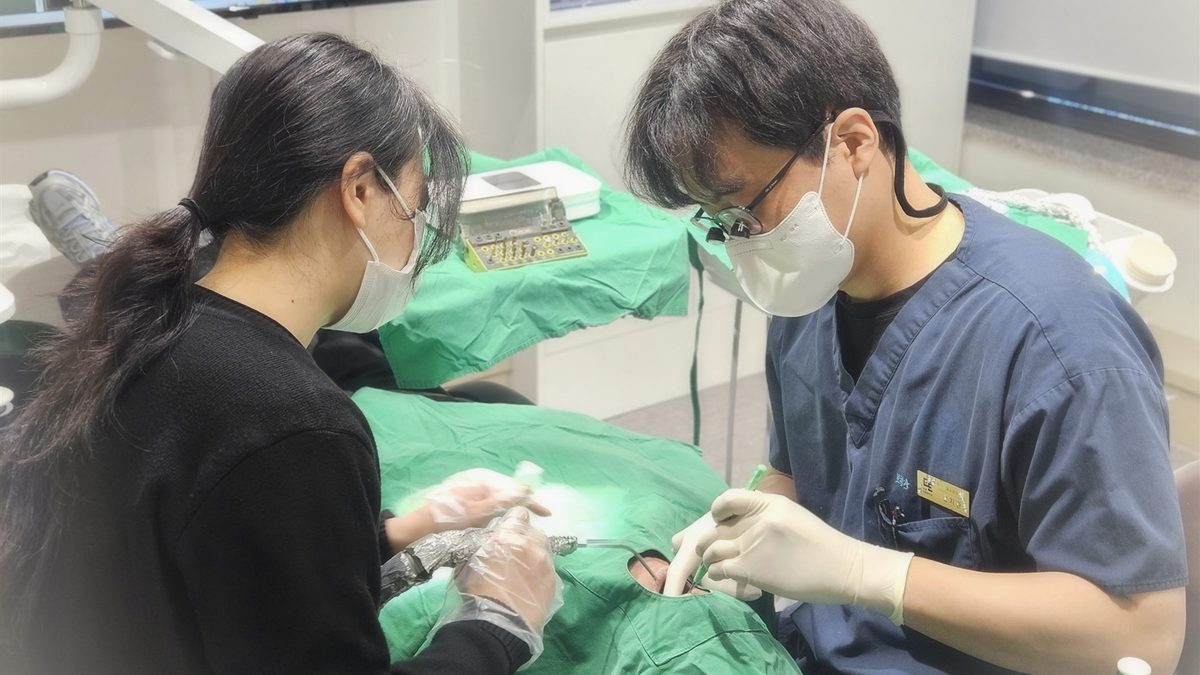
Key takeaway For a straightforward case, roughly three to four months from first consultation to final crown; with a bone graft, about six to nine. The surgery is one day — the rest is mostly waiting. What sets the timeline, how long each stage takes, how to live through the wait, and what "we'll shorten it" really means.
Hello. I'm Dr. Oh Ji-hwan, director of Yonsei The Strong Dental Clinic.
Numbers first. If the bone is in reasonable shape, plan on roughly three to four months from the first consultation to the final crown; with a bone graft, six to nine. But most of that span isn't time spent being treated — it's time spent waiting. The surgery itself is done in a day.
I open with that because the expression on people's faces after hearing "a few months" in the consultation room is usually the same. Many take it to mean being tied to the clinic for that whole stretch. Patients coming from Banghak Station, one stop up the line, ask it often: "So do I have to keep coming back and forth the whole time?" In practice, no.
To decide whether to start an implant, you first need to know how that time is used. What sets the timeline, how many days or months each stage takes, whether you go without a tooth while you wait, how cost and insurance work, and how far "we'll shorten the treatment" is actually true — in that order.
Why the timeline differs from person to person
An implant timeline is set not by the difficulty of the surgery but by how long the bone takes to grip the fixture.
An implant is a screw-shaped post placed in the jawbone, with a tooth-shaped crown fitted on top. Placing it isn't the hard part; what's needed after is for the post and the bone to lock together as one. That's called osseointegration, and it takes months. Skip that time and the post won't hold up to chewing force.
The way bone and fixture join isn't like gluing. Bone cells grow into the titanium surface and take hold, so there's no real way to speed it beyond letting the time pass. Lower jaws integrate faster than upper ones because the bone is denser, not because the surgery differs.
In other words, this is not a stretch a clinic can shorten by working faster. What can be shortened is the surrounding scaffolding — appointment gaps, how examinations are scheduled — not the time bone needs. Knowing that difference is what lets you hear a consultation's timeline properly.
The four things that set the timeline
| Variable | Shorter | Longer |
|---|---|---|
| Bone volume and density | Ample and dense bone | Insufficient bone, grafting needed |
| Timing of extraction | Long since lost, gum already healed | A tooth still there that must come out |
| Location | Lower molar region (denser bone) | Upper posterior (softer bone, sinus nearby) |
| General health and habits | Stable blood sugar, non-smoker | Uncontrolled diabetes, continued smoking |
The further right you sit in the table, the longer the waiting stretches. All four together can push it close to a year. That isn't treatment gone wrong — it's the conditions.
Which side am I closer to?
- It's been more than six months since the tooth was lost and the gum has healed over
- No one has told me on an X-ray that the bone is insufficient
- I'm not taking diabetes or osteoporosis medication
- I don't smoke, or I can stop
- The site is in the lower jaw
- There's no loose tooth still waiting to be removed
The more of these apply, the closer to the shorter end. This is only a rough gauge though — the real timeline can only be given after looking at an image. Bone condition isn't visible from outside.
With the variables clear, here's where the time actually goes.
How long each stage takes
The overall flow runs examination → (if needed) extraction and healing → (if needed) bone graft → placement → integration wait → crown → maintenance.
- Consultation and examination — one day. X-rays and three-dimensional imaging show bone thickness and height, nerve position, and the sinus. This is where the length of the plan is decided. You don't have to decide the same day; take the written plan home and think it over.
- Extraction and healing — about 4–8 weeks. If a tooth still needs removing, it comes out first. Placing after the socket has filled in somewhat is more stable. Where conditions allow, extraction and placement happen the same day, but not every site permits that.
- Bone graft — adds about 3–6 months when needed. If the bone is shallow or narrow, it's built up and left to grow. Sometimes done together with placement, sometimes separately beforehand. Lifting the sinus in the upper posterior adds time here.
- Placement surgery — about 20–40 minutes for one. Done under local anaesthetic; time rises with the number and position of fixtures. The surgery finishes that day. Sutures usually come out one to two weeks later.
- Integration wait — about 2–4 months. This is most of the total. You don't need to come often, so it passes with one or two check-ins. The lower jaw runs shorter than the upper.
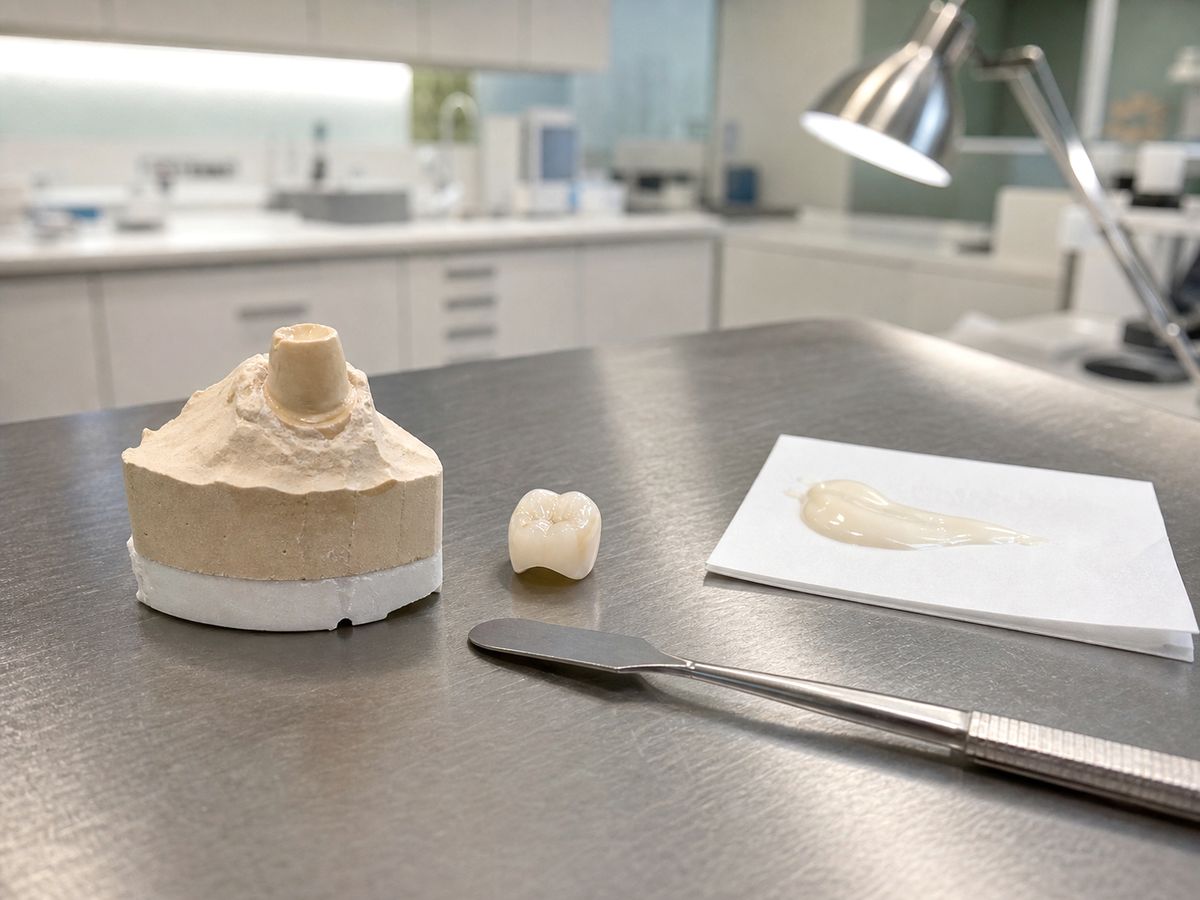
- Crown fabrication — about 2–4 weeks. An impression or scan, then the tooth that sits on the post is made. Matching shade and height brings you in two or three times. Adjusting the bite at the end finishes the treatment.
- Maintenance — ongoing. Around every six months we check the surrounding gum and the screw. Letting go here is where problems appear years later.
How surgery day actually goes
It's the day people are most anxious about, so here's the order in advance.
When you arrive we take your blood pressure and check how you are that day. If you're coming down with something or your blood pressure is well up, we sometimes postpone. Then local anaesthetic, which takes five to ten minutes to settle in while you simply sit. Opening the gum, preparing the site, placing the fixture and suturing is the surgery itself, and for a single implant it often finishes inside 20–40 minutes.
During the procedure there's a sense of pressure and the sound of the handpiece. Pain is handled by the anaesthetic, but vibration is felt — and knowing that in advance makes a real difference. If it gets hard, raise your hand and we stop.
Afterwards you bite on gauze for 30 minutes to an hour. Taking a painkiller before the anaesthetic wears off is easier, and it's best to avoid driving or hard exercise that day. Most people carry on normally from the next day, but swelling peaks on day two, so if you have something important on, book it after that.
Front teeth and molars are different problems
The same implant, but the concern shifts with the position.
For a front tooth, what matters more than chewing force is how it looks. The gum line has to match the neighbouring tooth, and shade and shape have to carry across, so the crown stage takes longer. The bone there is often thin, so grafting comes along more frequently.
Molars are the reverse. Less visual pressure, but they take chewing force directly, so initial stability and bite adjustment matter. In the upper posterior the sinus is close, which sometimes adds a lifting procedure and lengthens the timeline.
That's why "how many months for one implant" gets a question about position in return. The same count of implants gives a different schedule for one front tooth versus one last upper molar.
Questions I'm often asked
Q. Do I go without a tooth in the meantime? A. Mostly no. For a visible site like a front tooth, a temporary is made and fitted as standard, and molars are covered temporarily where needed. A temporary is exactly that, though — bite down hard on something firm and it can come off or break.
Q. Does doing several at once shorten things? A. The total does shorten, because the integration waits overlap. It's only possible within what your body can handle on the day, though, and the recovery load rises with it. Where the number and positions call for splitting, splitting is better.
Q. Can a tooth go straight on top the same day? A. In a limited set of very favourable cases, a temporary crown is fitted immediately — only where the bone is dense and initial stability is sufficient. It isn't available to everyone, so it isn't something I can promise before an examination.
Q. What if I can't come in for a long stretch? A. During the integration wait, a few weeks late is often no great matter. Before suture removal, or mid-way through the crown stage, it's a different story. If something comes up, check which stage you're at before postponing.
Q. Am I too old for this? A. Bone condition and general health matter more than age. I've treated people in their eighties, and I've postponed for people in their fifties whose conditions weren't right. Bring the list of medications you take exactly as it is and the assessment goes faster. Osteoporosis injections and anticoagulants in particular must be mentioned.
Q. How much does it hurt afterwards? A. Generally manageable with painkillers, and noticeably better after about two days. More fixtures, or a bone graft alongside, means swelling and discomfort last longer. Pain that gets worse from the third day is uncommon, so that's worth checking. There's individual variation here too.
With the timeline in view, here's the cost side.
Cost and health insurance
Implants are largely uninsured, but from age 65, national health insurance covers up to two in a lifetime, with a 30% patient share.
Where insurance doesn't apply, amounts differ between clinics. For reference, here are our posted in-clinic fees.
| Item | Posted fee |
|---|---|
| MegaGen implant | 890,000 KRW |
| Osstem SA implant | 990,000 KRW |
| Osstem BA implant | 1,090,000 KRW |
| Simple bone graft | 300,000 KRW |
| Complex bone graft | 500,000 KRW |
| Sinus lift (crestal) | 400,000 KRW |
| Sinus lift (lateral) | 700,000 KRW |
| Custom abutment | 200,000 KRW |
The full list is on our fees page, and period-specific notices are posted inside the clinic. When comparing quotes, don't look at the fixture price alone — ask whether grafting and connecting components are included. The same site gains line items once a sinus has to be lifted.
Why quotes look so different
There are usually three reasons the same site is priced differently from clinic to clinic.
One, the scope included differs. A quote listing only the fixture and one covering the abutment and crown aren't comparable to begin with. Whether the site needs grafting has to be established too.
Two, the materials differ. Fixture manufacturers vary in price, and the crown on top divides by material as well. It's less that one is better than that one suits the conditions.
Three, the aftercare plan differs. How reviews and adjustments are handled afterwards is sometimes built into the figure.
When comparing, look less at the total than at how many lines the quote has. Fewer lines leaves more room for items to appear later.
Setting timeline and cost against the alternatives, it comes out like this.
| Approach | Rough timeline | Are neighbouring teeth cut? | Notes |
|---|---|---|---|
| Implant | About 3–9 months | No | Long wait, but neighbouring teeth are left alone |
| Bridge | About 2–3 weeks | Two adjacent teeth are cut | Fast, but healthy teeth must be reduced |
| Partial denture | About 3–5 weeks | Only the clasp areas are shaped | Removable for cleaning; takes adjustment |
Faster isn't automatically better. A bridge is done in weeks but requires cutting the teeth on either side, and their lifespan is then tied into the structure. An implant takes longer but leaves those teeth untouched. Which suits you depends on the remaining teeth, your age and your circumstances taken together.
Since people often ask about longevity, one figure: in a paper on which I was first author, 804 patients and 1,780 implants were followed for up to 15 years, with a 15-year survival rate of 98.8% (J Clin Med 2023;12(6):2425, doi:10.3390/jcm12062425). That is a figure from cases where maintenance continued, and there is individual variation.
Since we're on money, here's how those months are spent.
Living through the wait
During the integration period, what decides the outcome isn't what happens at the clinic — it's a few things done at home.
By stage:
| Stage | How to get through it |
|---|---|
| Surgery day | Bite on gauze, cold compress, no hot food or straws |
| Days 2–3 | Peak swelling. Move from cold to lukewarm |
| Weeks 1–2 | Sutures out. Don't chew on the operated side |
| Rest of the wait | Normal life. With a temporary, just avoid hard food |
| Crown stage | A few days of unfamiliarity after bite adjustment |
Gathered in one place, the things that interfere with integration:
- Smoking — reduces blood flow to the gum and directly obstructs bone healing
- Uncontrolled blood sugar — affects both infection risk and healing speed
- Chewing on the operated side — force during the wait unsettles initial stability
- Grinding or clenching — a habit that loads the site overnight, often without you knowing
- Poking the site with a finger or tongue — irritates healing gum
- Hard exercise before sutures come out — raised blood pressure means more bleeding and swelling
The one to guard most is smoking. It's the condition most clearly tied to failed integration, so stopping — or at minimum cutting down — around the surgery changes the outcome. If you have diabetes, blood sugar control carries the same weight. Neither is something a clinic can do for you.
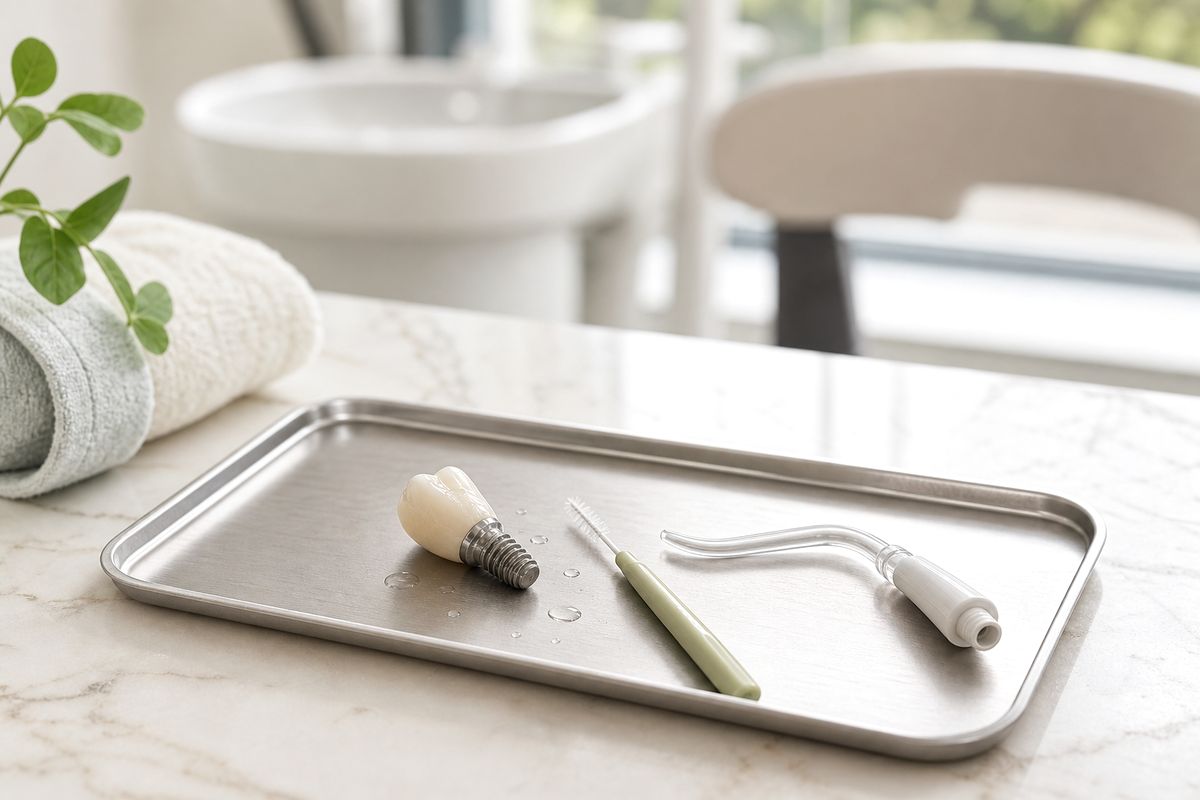
If this happens
The temporary tooth came out. Not a crisis in itself, but left out for long the neighbouring teeth drift and the crown may not fit later. Bring the piece and come in within a few days.
The gum on the operated side is still swollen after several days. Swelling usually peaks at day two or three and recedes. Getting worse from day four, or coming with heat, needs checking.
I can feel something at the site. The cover sitting above the gum is often what's felt. Usually normal — but if it feels loose, that's a different matter and should be looked at.
The wait is running longer than planned. Bone integrates at different speeds. If a check shows it hasn't taken hold, waiting a few more weeks beats forcing the next step and redoing it later.
The bite feels odd after the crown went on. Even fitted to height, a few days of strangeness is normal. But if one side contacts first, or a specific spot hurts on chewing, that's a signal for adjustment — don't put up with it. The adjustment takes minutes.
The other side has started hurting. Not using one side loads the other, and that happens. Worth checking separately from the implant site.
That's the whole picture. One last phrase to unpack.
"We can shorten the timeline"
Some stretches shorten and some don't. The time bone needs does not.
What can shorten: scheduling the examination and surgery close together, doing extraction and placement on the same day where conditions allow, placing several sites at once so the waits overlap, and tidying up the number of visits in the crown stage. All of that genuinely shortens with good planning.
Skipping the integration wait, on the other hand, only works in very favourable cases. When you hear timelines at a consultation, ask what exactly is being brought forward. Compressing appointments and shortening the wait are entirely different claims.
What to check at an implant consultation
- Do they take three-dimensional imaging and show you the screen? Bone height and nerve position aren't fully visible on a flat image.
- Do they break the total into stages? "Three months" isn't as useful as "two months to heal, three weeks for the crown" when you're planning around it.
- Do they tell you in advance whether grafting is likely? Sometimes it's decided during surgery, but the possibility should be raised beforehand.
- Do you get a written quote showing what's included? Told only verbally, there's no way to check when items appear later.
- Do they set a review interval for afterwards? An implant isn't a treatment that ends when it goes in.
You don't need to check all five. The second and fourth — stage-by-stage timing and a written quote — are enough to leave you something to compare against later. That holds for any clinic you're looking at.
Where things commonly go wrong
- Switching to a bridge in a hurry because the timeline feels long — you save weeks but cut two healthy teeth. If those give trouble later the loss is bigger.
- Skipping reviews during the wait — mid-course checks are needed even with no symptoms.
- Letting maintenance go once the crown is on — implants don't decay, but the surrounding gum does become inflamed. Most long-term problems start there.
- Collecting quote after quote — two or three comparisons is plenty; beyond that only the start gets delayed.
Coming from Banghak Station
Banghak Station is one stop up the line toward Uijeongbu, but we're not right by the station. Taking the subway, the walking at both ends adds up to around ten minutes all in. The clinic is about a five-minute walk from Exit 1 of Dobong Station, heading toward the Dobong 1-dong post office, and there's in-building parking if you drive (parking guide). Directions are on our how to find us page.
An implant runs over months, so whether the hours work for you genuinely matters. We're open until 9 p.m. on weekdays, until 2 p.m. on Saturdays, from 2 p.m. to 6 p.m. on Sundays, and on public holidays. There's more on our implant page and the dental team page.
To sum up
One, the total is three to four months for a straightforward case and six to nine with a bone graft. Most of that is waiting for bone to integrate, so you won't be at the clinic often.
Two, going without a tooth in the meantime is rare. A temporary is the norm — and a longer timeline usually reflects bone conditions rather than anything having gone wrong.
Three, ask for the timeline by stage rather than as a total. That's where what's being brought forward becomes visible.
Bone condition and healing speed vary widely, so an article can't pin your timeline down. Whether you're in Dobong-gu or over toward Banghak-dong, one image today tells us how many months the plan runs. Any questions, feel free to call us at 02-954-2080.
Most of an implant timeline isn't treatment time — it's waiting for bone to grip the fixture. Yonsei The Strong Dental Clinic is about a five-minute walk from Exit 1 of Dobong Station, open until 9 p.m. on weekdays and on weekends and public holidays.