My Dentures Keep Getting Loose — A Jangam Station Dentist's A-to-Z on Why It Happens and the Options up to Implant Overdentures
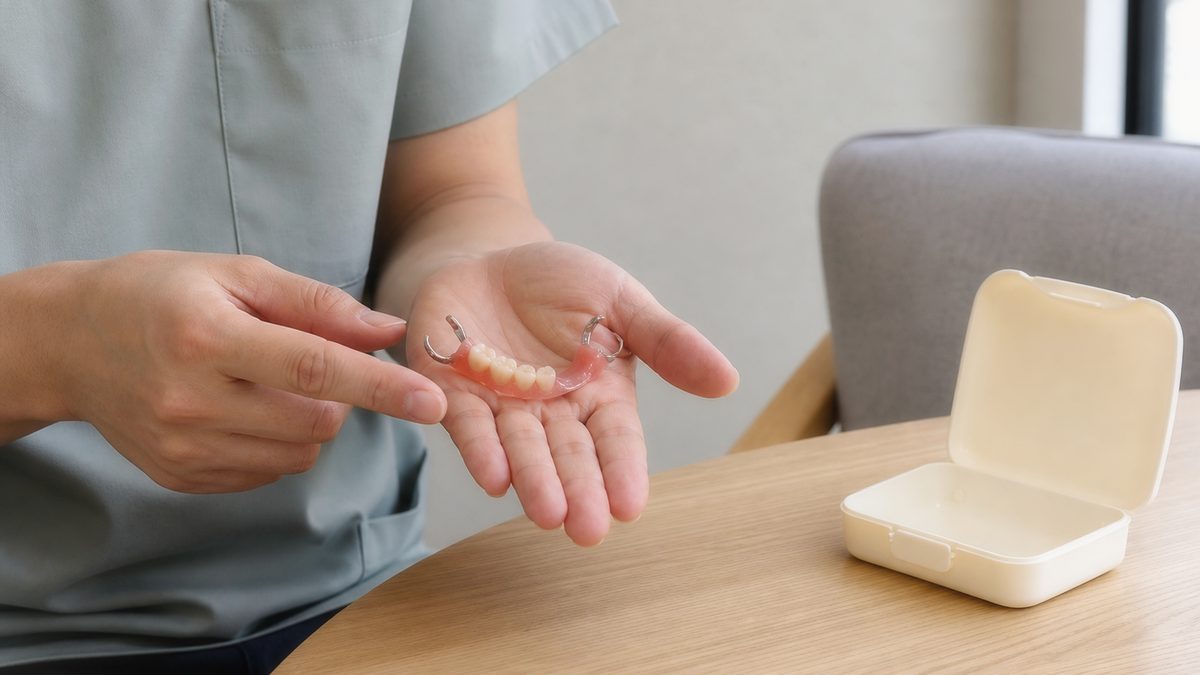
Key takeaway Dentures loosen not because they wear out but because the jawbone beneath them shrinks a little every year. While denture adhesive papers over the gap, the bone recedes faster. The ladder of fixes — adjustment, relining, remake — and when an implant-retained overdenture is the right rung, with costs and the 65+ national insurance combination.
Hello. I am Dr. Oh Ji-hwan of Yonsei The Strong Dental Clinic.
There is an item that often comes out of the bags of elderly patients who visit with their families: denture adhesive. Behind the daughter's explanation — "she can't eat without it" — there is usually a similar history. A denture that fit well for the first few years began to rock at mealtimes, and the layers of adhesive grew, one and then two, as the months of getting by went on. An elderly patient from Singok-dong told me she applies adhesive twice a day; another who comes from the Jangam Station direction said, "I thought the denture was just old, so I had a new one made — and within months it was loose again."
That last remark contains today's whole point. The main reason dentures loosen is not that the denture wears out, but that the jawbone supporting it is shrinking. That is why a new denture loosens again if the bone keeps receding. Today, in order: why the bone shrinks, how a loose denture is solved step by step, why leaning on adhesive is not the answer, who is suited to the implant overdenture — a denture snapped onto two or three implants like buttons — and the costs, including the 65+ national insurance combination.
Why does a well-fitting denture loosen?
In a jaw that has lost all its teeth, one quiet change continues. Bone is maintained by the stimulation tooth roots deliver; when that stimulation disappears, the bone is slowly resorbed and sinks. The same principle as an unused muscle thinning. It shrinks fastest right after teeth are lost, and keeps lowering a little every year after that.
A denture is a device that sits on this bone and holds by suction against the gum lining. When the supporting bone sinks, a gap opens between denture and gum, suction weakens, and the rocking begins. The denture is unchanged — it is the ground that is subsiding. That is why "just make a new one" is half an answer: a new denture fits today's ground, but does not stop the subsidence itself.
On top of this sits a vicious cycle. A loose denture slides over the gum with every chew, rubbing the lining; pressure sores and inflammation form; and the knocking of a moving denture on the bone actually accelerates resorption. The longer you wear it loose, the faster the ground sinks. Adhesive is only a curtain drawn over this cycle — it does not stop it.
One more thing: the lower jaw and upper jaw are different. An upper denture has the broad suction surface of the palate and holds out relatively long, but the lower jaw has a narrow suction area and a tongue that never stops moving — retention is inherently hard there. That is why "only my lower denture floats" is such a common complaint, and why the implant overdenture discussed below is considered first for the lower jaw.
The stages of looseness and their fixes
| Stage | Condition | Fix | Note |
|---|---|---|---|
| Slight lifting | Only certain spots lift subtly | Adjustment (smoothing contact areas) | Solved in a short visit |
| Overall looseness | Denture intact, but a gap has formed | Relining — new material added inside to re-fit today's gum | No new denture needed |
| Aged, worn denture | Worn artificial teeth, cracks, repeated repairs | Remake | Usually after years of use |
| Advanced bone loss | Loosens quickly even when remade; lower denture barely holds | Consider an implant overdenture | Fixed on 2–4 implants |
What I want to stress in this table: "loose" does not automatically mean "new denture." There are stages clearly solved by adjustment or relining — and, conversely, stages where even a remake is futile. Which row you are in can only be known by examining the gum and bone.
Checklist — where you stand now
- The denture rocks or clicks during meals
- Eating is difficult without adhesive, and the amount used keeps growing
- Food frequently slips underneath the denture
- Pressure sores or painful spots keep recurring on the gum
- It was recently remade, yet it is loose again
- The lower denture lifts at the mere movement of the tongue
- You long ago gave up hard foods because of the denture
- The lower face looks more sunken than before
The last item is a change that appears when bone resorption is well advanced. Three or more checks means it is time to assess the cause, not to buy more adhesive.
We need to talk about adhesive first
Adhesive itself is not evil. As a helper during the adaptation period of a new denture, or as insurance for an outing or a family event, it is useful. The problem is the moment adhesive becomes the daily precondition.
Needing adhesive for every meal means the gap between denture and gum has already widened by the thickness of that adhesive. While you fill that gap chemically, the denture keeps micro-moving, and a moving denture hastens bone loss. In other words, every month survived on adhesive quietly removes options from the next stage. A thick layer of adhesive also subtly changes the chewing height, loading the jaw joint.
So set the standard this way. Using adhesive "occasionally" is fine. Using it "daily, and more and more" means that money and effort should now go to fixing the cause. Adjustment or relining often costs about as much as a few months of adhesive.
Real questions, answered
Q. How often should dentures be remade? A. There is no fixed lifespan; it depends on how fast the jawbone changes. As a reference point, insurance-covered dentures become eligible for covered remake once 7 years have passed. What matters is not the year count but having the fit checked annually and catching early looseness with a reline. Daily cleaning and storage are covered in our denture care guide.
Q. What is relining? How is it different from remaking? A. Material is added to the inner surface of the denture so it hugs the present, sunken gum shape again. The outside and the artificial teeth stay; only the floor is re-laid — so cost and time are far lighter than a remake. If the denture itself is sound, it is the option to consider first.
Q. My lower denture is by far the worst — is it just me? A. Not at all. The lower jaw is structurally hard to seal, so a loose lower denture is the single most common complaint. And that is exactly where an implant overdenture is considered first — and where its effect is felt most.
Q. Can someone my age have implant surgery? A. The criteria are general health and bone condition, not age itself. With medications and conditions reviewed and a plan made, treatment proceeds in many elderly patients — and overdenture implants are few in number, so the burden is far smaller than full-arch implants. I have said in a Medical Today article (in Korean) that the harder the case, the more the plan matters.
The implant overdenture — sewing buttons onto the denture
The implant overdenture is, as the name suggests, a middle path between implants and dentures. Two to four implants are placed in the jawbone, buttons (attachments) are fitted on top, and the denture snaps on and off like a press stud.
What changes compared with a conventional denture? The source of retention. An ordinary denture relies on the suction of the gum lining; an overdenture is gripped by implants anchored in bone. Even as the ground sinks, the buttons stay put — the rocking is solved structurally.
The advantages are distinct. Chewing power recovers noticeably compared with a conventional denture, the anxiety of the denture lifting during speech fades, and you can leave adhesive behind. It still comes out for cleaning, so hygiene stays familiar. And because the implants transmit stimulation into the bone, a slowing of bone loss around them can also be expected.
The limits, told honestly. Surgery is required, and if bone is too scarce, grafting may come first. The button parts (rubber rings and the like) are consumables needing periodic replacement, and cleaning around the implants becomes a new homework item. And it is a different solution from full fixed implants — it is still a removable denture you take out to maintain. Choose knowing that.
Who it suits: those long troubled by a loose lower denture; those whose bone has sunk enough that even a new denture loosens quickly; those for whom full-arch implants are too heavy in cost and surgery but who want chewing function back. Conversely, we do not recommend it to those whose gums hold a conventional denture perfectly well, or those whose general health rules out surgery.
Costs and national insurance — check this if you are 65 or over
| Item | Insurance | Out-of-pocket guide |
|---|---|---|
| Denture adjustment | Covered | Roughly thousands to tens of thousands of won |
| Relining | Covered (conditions and frequency limits) | Around tens of thousands of won |
| Denture repair | Covered (by item) | Around tens of thousands of won |
| Insured denture remake (65+) | Covered — after 7 years, 30% co-payment | Varies by type |
| Implants (65+, 2 per lifetime) | Covered — 30% co-payment | Can be combined into an overdenture plan |
| Overdenture attachments, denture conversion | Usually not covered | On the order of hundreds of thousands of won |
| Bone graft (if needed) | Usually not covered | Varies with extent |
These figures are orientation ranges and vary greatly with condition and design. The key point is this: from age 65, dentures (7-year cycle) and implants (2 per lifetime) each carry national insurance, and in some cases the two can be combined into an overdenture plan — for example, using the two insured implants as lower-jaw anchors. Eligibility and remaining allowance depend on your history, so at consultation we check the insurance record together first. Remember also that prior registration is required.
How it proceeds (overdenture)
- Assessment: gum and bone condition, the current denture's fit, general health and medications are reviewed. Implant positions are planned on CT.
- Implant placement: usually 2 in the front lower jaw (in some cases 4 in the upper). The surgical scope is smaller than full-arch implants.
- Osseointegration wait: about 2–6 months for the implants to fuse with bone. The existing denture is adjusted for use meanwhile.
- Attachments and denture conversion: attachments go onto the implants and the mating parts into the denture base. Sometimes the existing denture can be used; sometimes a new one is made.
- Adaptation and maintenance: after practising insertion and removal, the attachment parts and the gums around the implants are checked regularly.
Care — the denture and the implants, together
- Take it out at night and store it in water. Gums need resting hours for bone and lining health. The same applies to overdentures.
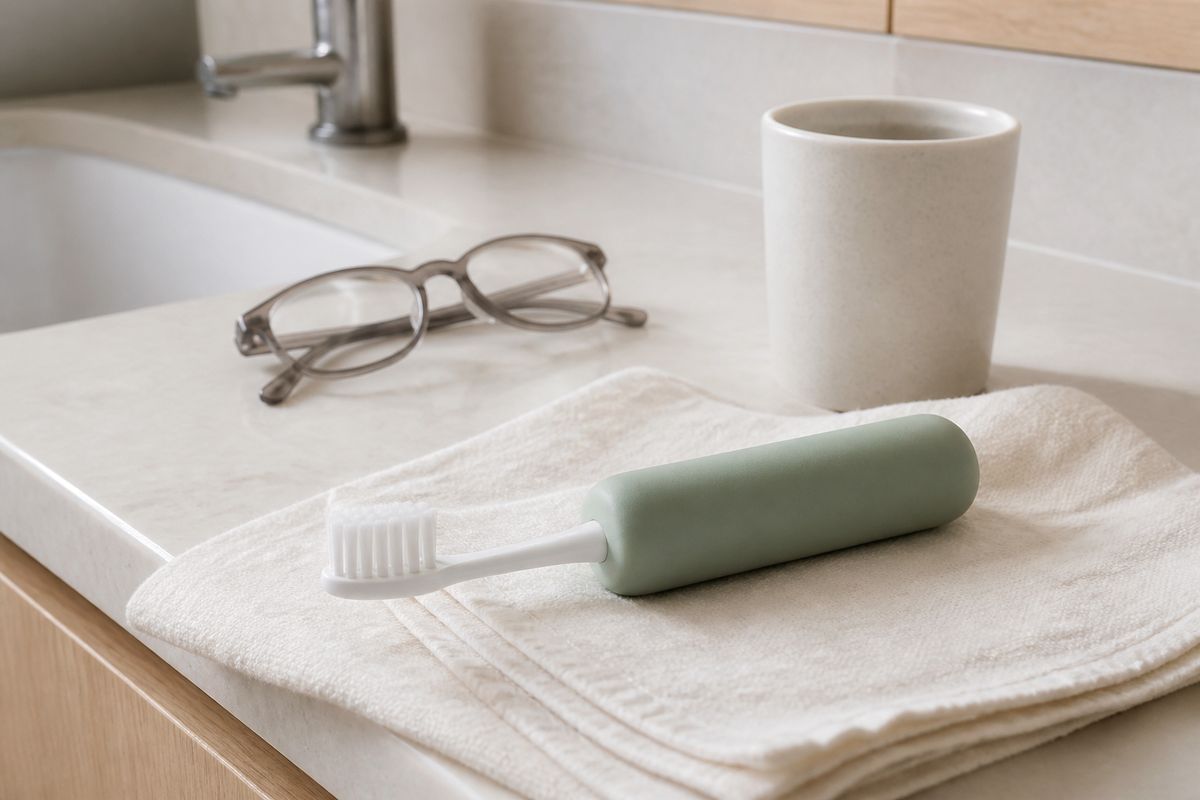
- Clean the denture with denture cleanser and a soft brush — never scrub with toothpaste (its abrasives scratch the surface).
- With an overdenture, brush around the implant buttons daily with a soft toothbrush. Inflammation around the attachments is the most common overdenture problem.
- Replace consumable parts such as rubber rings when they slacken. A sudden feeling of weaker grip often just means the parts are due.
- Have the fit checked once a year. Catching early looseness with a reline is the cheapest maintenance there is.
- Do not endure recurring gum sores. "Dentures just hurt" is not true. They can be adjusted.
Call us if
- A painful spot on the gum under the denture persists for days
- The denture cracks or an artificial tooth comes out
- The overdenture's grip suddenly weakens
- The gum around an implant button swells or bleeds
- Adhesive use has grown noticeably within a month
Choosing where to discuss it
- Do they show the whole ladder of options — adjustment → relining → remake → overdenture — with reasons for which rung you are on?
- Do they check your insurance history with you — remaining 65+ denture and implant entitlements folded into the design?
- Do they do the small jobs faithfully — adjustments and relines, rather than always recommending a remake?
- Is there prosthodontic depth? Dentures and overdentures are prosthetic design work. Our team is introduced on the doctor page.
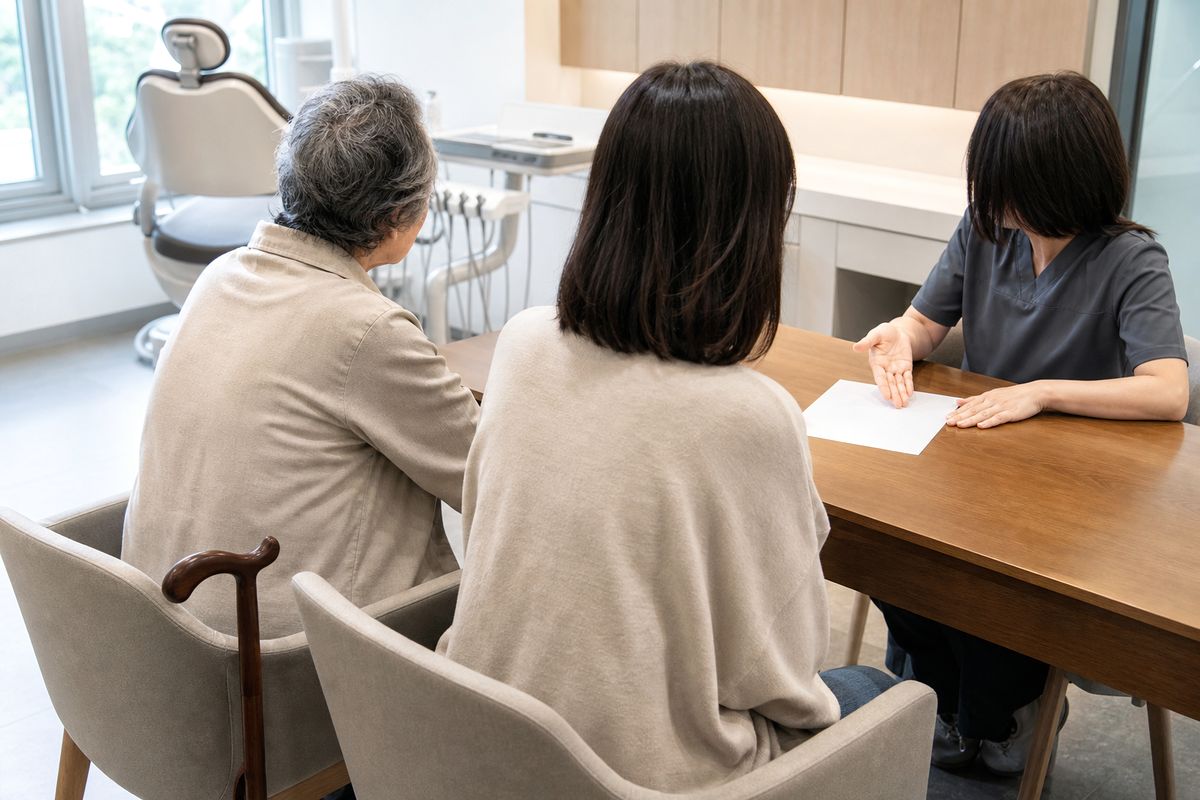
- Can family join the consultation? Elderly care continues at home when the family hears the plan too.
- Is it easy to keep visiting? A denture is not made-and-done; it is a device you visit to adjust. Weekend and evening hours are a practical criterion.
Three common failure patterns
First, holding out for years on adhesive. The bone sinks for every month endured, and when the decision finally comes, the options have narrowed.
Second, remaking every time it loosens. If the cause is bone loss, the new denture loosens at the same speed. Distinguish first: is this a reline stage, or a change-the-retention stage?
Third, closing the options yourself with "at my age, why bother." The overdenture is precisely a treatment whose quality-of-life change is largest in old age. Whether it is possible is decided by examination, not by age.
In closing
Three things, in summary. First, the culprit behind a loosening denture is not the denture but the subsiding jawbone — and the longer a loose denture is endured on adhesive, the faster the bone recedes. Second, the fixes form a ladder — adjustment, relining, remake, and the overdenture fixed on 2–4 implants. A new denture is not always the answer. Third, from age 65 the separate insurance benefits for dentures and implants can sometimes be combined, so before buying more adhesive, have your insurance history checked. If adhesive has started appearing in a parent's bag, that is the signal for a consultation. Conditions vary greatly by individual, so the precise stage is confirmed on examination.
Today in one line: the culprit of a loose denture is not the denture but the sunken ground beneath it. Adhesive is only a curtain — first find your rung on the ladder of adjustment, relining and overdenture.
Our clinic sees patients until 9 p.m. on weekdays and opens 365 days a year, so bringing a parent after work or on weekends is easy to arrange. Our clinic's AI phone guidance also runs 24 hours a day after closing. We are about a five-minute walk from Exit 1 of Dobong Station, Seoul (towards Dobong 1-dong Post Office), and a few train stops from Jangam Station — close for the Jangam and Singok-dong areas of Uijeongbu as well. If you are driving, please see our parking guide.