Do I Really Need Gum Surgery? — A Mangwolsa and Dobongsan Station Dentist on When Periodontal Surgery Is Needed and How Recovery Goes
Key takeaway Gum surgery is done only where pocket depths remain after scaling and non-surgical gum treatment. The gum is lifted so the root surface and bone shape can be seen and cleaned directly. It is done under local anaesthetic, and most people are back to normal within one to two weeks. Here are the criteria, the types, recovery, insurance coverage, and the cases where we do not recommend surgery.
Gum surgery is only performed at sites where the pockets have not shrunk despite scaling and non-surgical gum treatment. The gum is lifted slightly so that the root surface and bone shape can be inspected and cleaned, then closed again. It is done under local anaesthetic, so pain during the procedure is uncommon, and most people return to normal life within one to two weeks.
Hello. I am Dr. Jihwan Oh of Yonsei The Strong Dental Clinic.
When I tell someone who has already had a few sessions of gum treatment that "this back tooth may need surgery," nine out of ten faces tighten. The questions that follow are almost always the same. How much does it hurt, how many days off do I need, and what happens if I don't do it. Then, a little later, one more: "Do I really have to?"
It is a fair question. Gums are not an area people come in for because of pain; they are an area people come in for because a tooth has suddenly become loose. From the patient's side, being told to have surgery on a place that is not even particularly uncomfortable does not sit easily. Some of the people who ride two stops on Line 1 toward Seoul from Mangwolsa Station, passing Dobongsan Station on the way, have spent years repeating gum treatment somewhere in Uijeongbu before coming here.
Today I want to answer that question from the beginning. What gum surgery actually does, what criteria we use to decide it is needed, how the types differ, what the pain and recovery are really like, how far national health insurance covers it, and when we do not recommend surgery.
What does gum surgery actually do?
The gum is lifted so the root surface and bone can be seen directly, inflamed tissue and remaining calculus are removed, and the gum is closed again.
The name sounds alarming, but what is done is not very different from the gum treatment you already had. The goal is identical: to remove the calculus and inflamed tissue clinging to the root surface. The difference is whether it is done with sight, or without it.
Scaling and non-surgical gum treatment (root planing and curettage) work by passing instruments below the gum line without opening it, relying on feel. In shallow areas this works well. But as the pocket deepens, and as calculus settles into furcations where roots divide or into hollows in the root surface, blind spots appear that instruments cannot reach. Gum surgery lifts the gum briefly so those spots can be seen and cleaned.
How is it different from non-surgical gum treatment?
| Non-surgical gum treatment | Gum surgery | |
|---|---|---|
| Method | Instruments passed below the gum without opening it | Gum lifted, cleaning done under direct vision |
| Visibility | Relies on tactile feedback | Root surface and bone shape seen directly |
| Typical depth | Shallower pockets | Deep pockets remaining after non-surgical care |
| Anaesthetic | Local | Local |
| Sutures | None | Sutures placed, usually removed after one to two weeks |
| Recovery | Some sensitivity for a few days | Swelling for two to three days, back to normal in one to two weeks |
The row worth noticing is the anaesthetic. Both treatments are carried out under local anaesthetic. The gap is not as wide as the worry that "surgery must hurt far more" suggests. What differs is the recovery period.
Check first whether this applies to you
If several of the following apply, surgery may come up at your examination. This is a rough guide only; the actual decision is made after examination.
- You have had scaling and gum treatment, but the same spot swells again a few months later
- One or two particular back teeth bleed and smell noticeably more than the rest
- You have been told at an examination that "this area probes deeper than five or six millimetres"
- Your gums have receded, roots are exposed, and food packs into the gaps often
- A tooth feels slightly looser than it used to
- You have repeated gum treatment for years without ever being told it had improved
Conversely, if your gums bleed occasionally or feel sensitive after scaling, you are not at the stage where surgery comes up. At that stage, proper staged gum treatment settles most cases.
In the end, the decision rests on the examination numbers. Let us start with what those numbers are.
What tells us that surgery is needed?
We look at pocket depth, signs of inflammation, bone shape on radiographs, and how the site responded to non-surgical treatment.

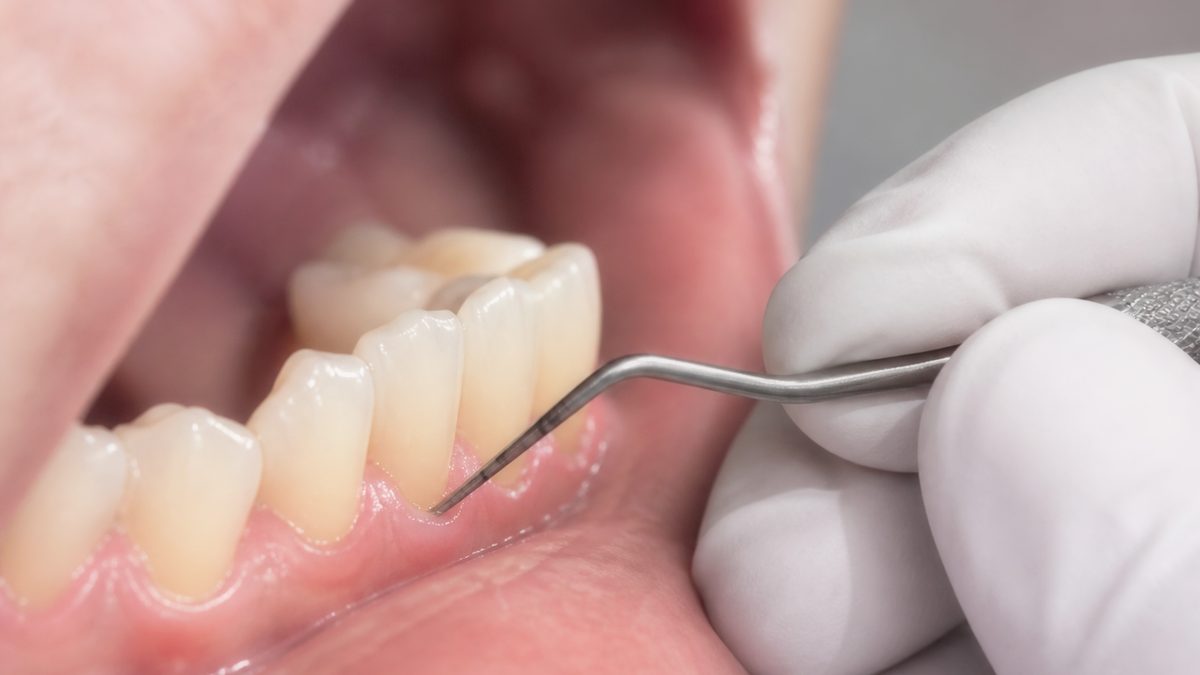
You have probably had the examination where the dentist prods around the gums and calls out numbers. A thin graduated instrument is placed between gum and tooth to measure depth, and this is called periodontal probing. The rough guide is as follows.
| Pocket depth | How it is usually read | Main treatment |
|---|---|---|
| 1–3 mm | Healthy range | Scaling and maintenance |
| Around 4 mm | Early periodontitis | Non-surgical gum treatment |
| 5–6 mm or more | Instruments start to struggle | Gum treatment, then reassessment; surgery considered for what remains |
A misunderstanding often starts here. A reading of six millimetres does not mean surgery straight away. There is an order. Non-surgical gum treatment comes first, then the site is measured again after roughly four to six weeks and compared. If depths have decreased and the bleeding has stopped, we move to maintenance without surgery. If a few sites remain unchanged, surgery is discussed for those sites only.
Depth is not the only thing we look at, either.
- Bleeding on probing: whether the site bleeds when measured. It signals that inflammation is still active
- Bone shape on radiographs: whether the bone has flattened evenly, or whether one root is flanked by a valley-like defect. A defect shape is what allows regenerative treatment to be considered
- Furcations: where the roots of a molar divide, instruments have particular difficulty reaching
- Tooth mobility: if mobility is severe, a different decision may come before surgery
- General health and smoking: both affect healing directly
Some common questions
Q. Can I just keep having non-surgical gum treatment instead? A. You can. But if deep sites remain, those sites are likely to stay as they are. Continuing gum treatment is closer to slowing the progression than to reducing the depth itself. Whichever route you take, outcomes vary between individuals.
Q. It doesn't hurt at all right now, so why do it? A. Gum disease is a condition where pain arrives late. By the time it hurts, a good deal of bone has often already been lost. Not hurting is not the same as being fine.
Q. Will my gums grow back after surgery? A. Usually not. As gums that were swollen with inflammation settle down, teeth may in fact look longer and the gaps between them more open. I will come back to this later.
What are the different types?
They are divided by how far the gum is lifted and what the aim is. Broadly, there are procedures that only clean, and procedures that attempt to rebuild bone.
| Name | What it does | When it is used |
|---|---|---|
| Gingivectomy | Trims and reshapes overgrown gum tissue | When swollen, overgrown gums make cleaning impossible |
| Flap surgery (open flap debridement) | Lifts the gum, cleans root and bone directly, then sutures | The standard approach in periodontal surgery |
| Bone grafting / guided tissue regeneration | Places graft material into a bone defect and covers it with a membrane | When the bone has a valley-shaped defect and regeneration can be attempted |
| Crown lengthening | Adjusts gum and bone height to expose more tooth | When decay or fracture extends below the gum line and restoration is difficult |
The second one, flap surgery, is the most common. When people say "gum surgery," they usually mean this.
The third, regenerative treatment, depends on conditions being right. What decides it is the shape in which the bone was lost.
Bone is lost in broadly two ways. In one, the height drops evenly across several teeth. In the other, a well-like defect forms beside a single tooth. Regenerative treatment works better in the latter, and the more bone walls remaining around that defect, the better. Graft material needs a container to sit in before new bone can establish itself. Where the bone has flattened evenly, there is nowhere for the material to stay, so we clean the site and contour the gum height instead.
That is why "can a bone graft save it?" is a question I answer while looking at the radiograph with you. It is a point where a single image changes the decision, so looking at the screen together is quicker than describing it. And even when regenerative treatment is done, I cannot promise that bone will return to its original height. How much fills in varies considerably with the defect shape and with how the site is maintained.
The fourth, crown lengthening, is less a treatment for gum disease than preparation for a restoration. When decay or a fracture extends below the gum line, fitting a crown over it leaves the margin buried in the gum, where inflammation keeps recurring. So the gum line is lowered slightly to expose more tooth. Decisions like this have to be made alongside the restorative plan, which is why specialists in prosthodontics, conservative dentistry and advanced general dentistry review it together at our clinic.
What you must tell us before surgery
Medications and medical conditions can change both whether and when surgery is done. Please do not leave them out.
You fill in a medical history form at reception, but people often skip the entries that matter most, thinking "this can't have anything to do with the dentist." Here is what we pay particular attention to.
| What to tell us | Why it matters |
|---|---|
| Aspirin, anticoagulants and other blood-related medication | It changes how we plan for bleeding. Do not stop them on your own — speak to the doctor who prescribed them first |
| Osteoporosis medication (oral or injected) | Depending on the type and duration, jaw healing can be affected, so we adjust the extent and timing |
| Diabetes | Blood sugar control affects healing speed and infection risk |
| Heart or valve conditions, joint replacements | Antibiotic cover before the procedure is sometimes needed |
| Immunosuppressants or cancer treatment | Timing has to avoid clashing with your treatment schedule |
| Pregnancy or breastfeeding | Radiographs and prescriptions are planned differently |
| How much you smoke | It affects healing and outcome directly. Being straightforward here helps |
I stress the first two rows in particular. Patients do sometimes stop blood-related medication for a few days on their own judgement, and that can create a far more dangerous situation than dental bleeding. Whether to adjust the medication is for the prescribing doctor to decide; we prepare our haemostasis around that decision.
The same goes for osteoporosis medication. Taking it does not mean surgery is impossible. But the approach differs by type and duration, so we need the name of the drug and when you started it. A photo of the packaging or prescription is the most accurate thing to bring.
Q. I'm taking cold medicine. Is surgery still okay? A. Usually it is not a problem. But if you have a fever or are generally run down, healing is less favourable, and I may suggest postponing by a few days.
Q. Can I eat breakfast on the day? A. Yes. This is done under local anaesthetic, so fasting is not required. Having a light meal beforehand is in fact better than arriving on an empty stomach.
What actually happens on the day
The sequence is usually as follows. Time and number of visits vary with the site and extent.
- Anaesthetic: the area is numbed. For many people this is the least comfortable moment of the whole procedure.
- Lifting the gum: the gum margin is carefully raised. The gum is not cut away; think of it as opening a door and closing it again.
- Cleaning: inflamed tissue is removed and remaining calculus on the root surface is cleaned under direct vision. This is the core of the treatment.
- Grafting if needed: if the bone defect has the right shape, graft material is placed and covered with a membrane.
- Suturing: the gum is repositioned and sutured. Sutures usually come out after one to two weeks.
A single session commonly takes around thirty minutes to an hour and a half, depending on how many sites are involved. We do not treat the whole mouth at once. It is normally divided into upper and lower, left and right, over several appointments, so that you can eat and heal on one side at a time.
Q. Do I go home the same day? A. Yes. This is a local anaesthetic procedure, so there is no recovery room stage. Just avoid hot food until the numbness wears off, as your lip and cheek will be dull to sensation.
Q. How many visits will it take? A. The surgery itself is one visit per site. Suture removal and follow-up reviews are added to that. The overall schedule depends on how many sites are treated.
Q. Can implants or crowns be done at the same time? A. We set an order. If a restoration is made while gum inflammation is still present, the gum settles afterwards and the margins no longer fit, which can mean redoing the work. Usually the gums are treated first, the result is reviewed, and then the restorative plan is made.
Does it hurt, and how long do I need to rest?
This is the most common question, so here it is in order of time. The following is a typical course, and it varies with extent and with the individual.
| Stage | Common experience | What to do and avoid |
|---|---|---|
| Same day | Aching as the anaesthetic wears off, slight blood in saliva | Take prescribed medication, cold compress. Avoid hot food, alcohol and vigorous exercise |
| Days 1–3 | The peak period for swelling and discomfort | Soft food, chew on the other side. No brushing of the surgical site |
| Days 4–7 | Swelling starts to subside | Most daily activity is fine. Use the prescribed mouthwash |
| Weeks 1–2 | Sutures removed, gum contour settles | Begin brushing the site gently with a soft brush |
| Months 1–2 | The gum settles into place | Return to normal brushing, resume floss and interdental brushes |
Many people worry about work, but this is not a treatment that requires days off. That said, on the day of surgery and the day after there is swelling and some awkwardness in speaking, so it is better to avoid scheduling anything important.
Q. Tell me honestly how much it hurts. A. During the surgery, most people feel nothing because of the anaesthetic. The issue is after it wears off, and many describe it as similar to or milder than a wisdom tooth extraction. For most people it is manageable with the prescribed medication, but pain varies between individuals, so I will not tell you flatly that it does not hurt.
Q. I've heard the gaps between teeth open up and teeth look longer. Is that true? A. It is true. And it is not a sign that something went wrong. When gums that were swollen settle, the original bone level becomes visible, which is what produces the change. It can be particularly noticeable at the front, so for front teeth we explain the aesthetic change before deciding. There is more in the piece on gum recession.
Q. The treated tooth is more sensitive now. A. That is a common reaction as the root surface becomes exposed. It often eases with time, and a desensitising toothpaste or a separate treatment can help. If it is still severe after several months, it needs to be looked at again.
If any of this happens after surgery
Most of it is within the expected range. A few things, though, warrant a call.
These happen after you have gone home, so I am writing them down in advance. Our clinic's AI phone service takes calls around the clock even outside consultation hours, so if you are unsure, it is better to call.
| If this happens | What to do |
|---|---|
| A little blood in the saliva | Common on the first day. Bite firmly on gauze for twenty to thirty minutes |
| Bleeding that does not stop and keeps pooling | Bite on fresh gauze; if it continues, call us |
| A suture comes out after a day or two | Usually fine, but let us know so it can be checked |
| Swelling worsening from the third day | Swelling should be receding by then. It needs checking |
| A bad smell | Common during the days when the site cannot be brushed. Use the prescribed mouthwash |
| A whitish film over the gum | Often tissue that forms as part of healing |
| Fever with swelling spreading to the face | Call us straight away. It is better checked the same day |
Q. When can I start brushing again? A. Not over the surgical site until the sutures are out. Everywhere else should be brushed as usual. Leaving the whole mouth unbrushed works against healing.
Q. When can I smoke again? A. Honestly, smoking is one of the factors that most affects the outcome of this treatment. I would ask you to hold off at least through the healing period, and if it is possible at all, we would rather discuss using this as the moment to stop.
Q. What about exercise? A. Avoid anything that raises your heart rate for the first two to three days. Walking is fine.
Q. And alcohol? A. Because of bleeding and the medication, it is better avoided for at least a few days. The exact point depends on what has been prescribed, and we will advise you.
What about the cost and insurance?
Gum treatment is covered by national health insurance. So is gum surgery.
| Item | Covered? | Notes |
|---|---|---|
| Scaling | Covered once a year from age 19 | Additional sessions in the same year are not covered |
| Non-surgical gum treatment (root planing, curettage) | Covered | Charged per site |
| Gum surgery (gingivectomy, flap surgery) | Covered | Charged per site |
| Regenerative treatment using graft material or membranes | Materials and techniques may include non-covered items | We tell you before they are used |
The exact figure depends on how many sites are treated and whether regenerative treatment is involved, so it is hard to quote a number before examination. What is worth knowing in advance is that gum surgery is a covered treatment, not a private-fee procedure. Many people arrive picturing the sums involved in implants or crowns; this is a different kind of treatment.
Published private-fee amounts are listed on our treatment fees page. Notices can change from period to period, so please check the notices posted in the clinic and the explanation given at your consultation as well.
One more thing. Gum surgery is an attempt to keep a tooth. If the same site is left alone and the tooth is eventually extracted and replaced with an implant, the order of magnitude of the cost changes entirely. This is not a decision to make on today's figure alone.
How long does it last after surgery?
There is no fixed period. Whether the maintenance interval is kept makes a large difference.
I would like to answer "it lasts X years," but honestly, no such number exists. Gum disease is not an illness that resolves like a cold; it is closer to diabetes or high blood pressure, something that is managed. Surgery restores a deteriorated site, and holding that site is a separate matter.
In practice, outcomes tend to fall into three groups.
- Holding well: people who come at the set intervals and clean between their teeth. Depths stay shallow for a long time, and each check-up is a matter of tidying up and going home
- Slowly deteriorating again: the surgery went well, but maintenance intervals were missed. Depths creep back over several years
- Recurring quickly: often people who continue to smoke, or whose blood sugar is difficult to control
The same surgery, and outcomes divide like this. That is why, when I explain a surgical plan, I explain the follow-up interval alongside it. If a date has been set for surgery with nothing said about what comes after, only half the plan exists.
Q. If I look after it well, will my gums return to how they were? A. Lost bone does not return fully to its original height. The aim is not to turn back the clock but to keep what is still there. I say this plainly from the outset.
Q. How often do I need to come? A. It varies with the situation, but usually every three to six months. We start with shorter intervals and lengthen them as things stabilise.
What comes after matters more than the surgery
Frankly, what determines the outcome of gum surgery is less the surgery than what follows. Surgery brings a deteriorated site back close to its starting point; keeping it there is a different job.
- Check-ups every three to six months: gums that have been treated deepen again if maintenance lapses. We check at set intervals and tidy up as needed
- Interdental brushes and floss: a toothbrush does not clean between teeth. Sites that have just been cleaned surgically are exactly where trouble restarts
- Stopping smoking: smoking is known as one of the lifestyle factors with the greatest effect on the outcome of gum surgery. Healing is slower and recurrence more frequent
- Blood sugar control: if you have diabetes, it and your gums influence each other. There is more in diabetes and gum care
- Clenching and grinding: continued force on a mobile tooth accelerates bone loss. We consider a guard where appropriate
This is the part I emphasise most to patients who have had surgery. I can clean a site well; keeping it that way for years is something we do together.
How does this fit with implants and restorations?
Gums are treated first, the result reviewed, and only then are restorative or implant plans made.
Reversing that order can mean redoing work later. Two reasons.
First, gums settle after treatment. As gums swollen with inflammation return to position, the gum line drops. A crown made before that can end up with a visible margin or a gap, and may have to be remade. At the front, more so.
Second, poor gum health next to an implant site affects the implant. Inflammation similar to gum disease can develop around implants, and a deep pocket on the neighbouring tooth can be where it starts. So when planning an implant we look at the surrounding gum condition too. There is more in the piece on peri-implantitis.
In short: treat the gums, reassess, then plan restorations and implants. That said, there are situations where function has to be restored temporarily first, such as when teeth are too mobile to chew on. In those cases we adjust the order, but we explain why before proceeding.
When we do not recommend surgery
Not every deep pocket is treated surgically. In the following situations we suggest another direction first.
| Situation | Why we do not recommend it | What we do instead |
|---|---|---|
| The tooth is already very mobile and bone loss is extensive | There is not enough bone left to support it after surgery | Discuss the timing of extraction and what follows |
| Home care is not yet established | The same site will deteriorate again shortly | Settle brushing and interdental care first, then reassess |
| Smoking will continue | Outcomes can be noticeably worse | Adjust timing alongside a plan to stop |
| General health is unstable | Healing and infection risk have to be assessed first | Decide after confirming with your physician |
| Depths have reduced enough after non-surgical treatment | There is no longer a reason to operate | Move to maintenance |
That last row happens more often than you would think. Even when surgery came up at the first examination, patients who complete gum treatment diligently and get their home care in order sometimes reach a reassessment where the conclusion is not to operate. That is why we do not book a surgery date on the first day.
If you have been told you need gum surgery
Whether you heard it elsewhere or from us, these are worth checking before deciding.
- Ask whether non-surgical treatment came first, and whether the site was measured again afterwards. Whether the sequence was followed matters most
- Ask how many teeth and how many sites. "Gum surgery" on its own tells you nothing about the extent
- Ask to see the measurements. Pocket depths and radiographs are easier to understand while they are being explained
- Check whether regenerative treatment is included, and whether any part of it is not covered by insurance
- See whether a maintenance plan is being discussed alongside it. If there is talk of surgery but none of follow-up intervals, ask again
- If you have your records, there is nothing wrong with getting a second opinion. We review records you bring rather than repeating the imaging
To sum up
Three things are enough to remember.
First, gum surgery is not what you do because your gums are bad; it is done only at sites that remain after non-surgical treatment. Check that no step was skipped.
Second, pain and recovery are shorter than most people fear. It is done under local anaesthetic, and most people are back to normal within one to two weeks. What is worth knowing beforehand is that teeth may look longer as the gums settle.
Third, what decides the outcome is the three-to-six-month maintenance and stopping smoking. Treatment is only complete when that is part of the plan.
If you are wondering where your gums stand, you are welcome to have an examination and decide later. We make a point of not rushing treatment on the first visit. Directions are set out separately for coming from Mangwolsa Station and coming from Dobongsan Station. Dobong Station is two stops from Mangwolsa and one from Dobongsan on Line 1, and the clinic is about a five-minute walk from Exit 1. It sits where southern Uijeongbu meets Dobong-gu in Seoul, so it is not difficult to stop by after work or at the weekend.
Gum surgery is done only at the deep sites left after gum treatment. It is carried out under anaesthetic, so pain during it is limited and most people are back to normal within one to two weeks; what protects the result afterwards is regular review and stopping smoking. We are open until 9pm on weekdays and on Saturdays and Sundays, so finding a time is not difficult. Treatment outcomes vary between individuals.